




Water Cooling Spindle for Stable High-Speed Machining
A water cooling spindle helps solve one of the most common machining problems: heat. When a spindle runs at high speed, temperature rise can affect bearing life, surface finish, and long job consistency. For shops that need reliable cutting over long runs, a water cooling spindle is often chosen to keep thermal growth under control and maintain stable output in compact CNC equipment.
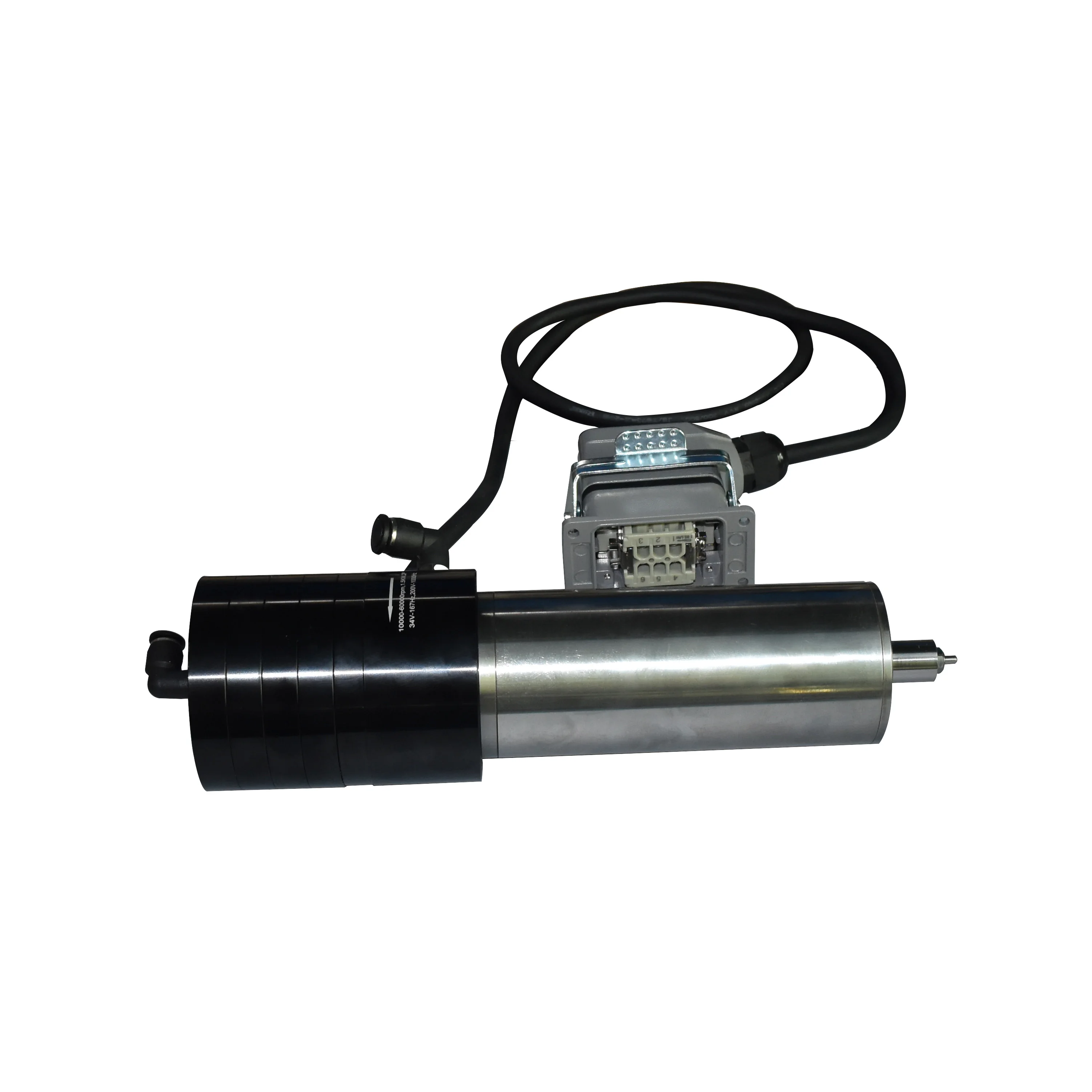
The product shown is presented here as an industrial electromechanical assembly with a cylindrical body, integrated cable, and connector interface. Visible features suggest a precision motion component used in machinery. Because only the image is available, exact internal type, power rating, and speed should not be assumed. For buyers evaluating a CNC spindle motor or related drive unit, the main value is the same: controlled motion in a compact package with practical electrical integration.
Product Overview
This type of assembly is typically used where a machine needs repeatable motion, a protected housing, and straightforward cable connection. In CNC systems, similar form factors may be used as a high speed spindle, a CNC drilling machine spindle, or a compact drive component in automation equipment. The visible connector and shaft/output end indicate that the unit is designed for installation into a larger mechanical system rather than standalone use.
For applications where spindle heat can reduce accuracy or shorten bearing service life, water-cooled designs are preferred over air-cooled options in many workshops. A properly selected water cooling spindle can improve thermal stability, especially during continuous operation or fine-detail machining.
Key Specifications and Capabilities
Visible construction
The unit shows a two-tone metal housing, with a darker front section and a silver rear body. A protruding shaft or rod is visible at one end, and a multi-pin connector with a cable harness is mounted externally. These are useful clues for installation planning, but they do not confirm exact performance data.
Typical capability areas buyers review
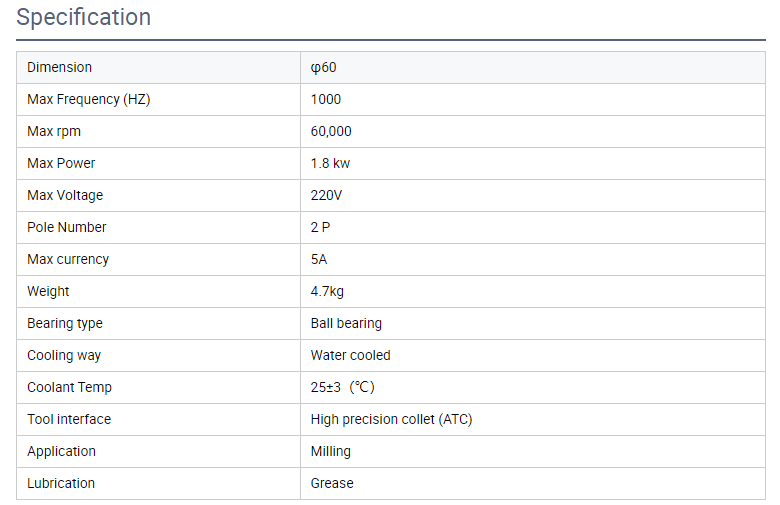
When comparing a ball bearing spindle or a 60000rpm spindle, buyers normally check speed range, runout, load capacity, cooling path, and mounting interface. Those values are not provided here, so any final selection should be based on the machine’s torque requirement, tool size, duty cycle, and control system compatibility.
Materials and Finish Options
From the visible surfaces, the housing appears to be metal, likely aluminum or steel on the silver section, with a coated black front cover. That kind of construction is common in precision assemblies because it balances rigidity, heat management, and compact form. The cable insulation appears to be a black polymer, while the connector body includes metal and molded plastic elements.
In similar products, finish options may include anodizing, powder coating, or other protective treatments to improve corrosion resistance and surface durability. If your machine is used near coolant mist, dust, or vibration, finish selection matters because it affects service life and ease of maintenance.
Manufacturing and Assembly Considerations
Although the exact process cannot be confirmed from the image, products in this category are generally made through machining of cylindrical housings, precision assembly of internal rotating or linear components, electrical termination, and connector integration. In a spindle-related product, bearing fit, concentricity, and cable sealing are especially important because they influence vibration and thermal behavior.
For OEM buyers, it is worth asking how the part is assembled, how the connector is fixed, and whether the cable exit is strain-relieved. These details often determine whether a CNC spindle motor performs well under daily production use.
Application Scenarios
This style of compact electromechanical unit is used in automation equipment, robotics, test fixtures, motion control systems, and industrial machinery requiring controlled pushing, pulling, rotation, or actuation. In CNC environments, a related spindle assembly may be used for drilling, engraving, routing, or other light-to-medium duty machining tasks.
Buyers choosing a high speed spindle usually care about process stability more than headline speed alone. A machine running at 60000rpm can still perform poorly if the mounting, cooling, and tool interface are not matched to the application.
Quality Control Points
For this type of product, quality checks usually focus on dimensional consistency, shaft alignment, connector integrity, cable continuity, insulation condition, and smooth mechanical operation. If it is used as a ball bearing spindle or similar rotating component, bearing noise and vibration are also important inspection points.
Before purchasing, ask for inspection criteria that match your machine needs, especially if the spindle will run for long cycles or in a production cell. For replacement parts, confirm connector pinout, mounting dimensions, and interface compatibility with the existing equipment.
Customization Guidance
Customization is often useful when integrating a spindle into an OEM machine. Common requests include cable length adjustment, connector changes, housing finish changes, mounting adaptation, and revised cooling port layout. If the unit is part of a CNC drilling machine spindle setup, matching the control signal, power supply, and physical envelope is more important than choosing a generic catalog part.
How to Choose the Right Unit
Start with the workpiece material, target speed, required torque or force, duty cycle, and available cooling method. Then check the installation space, interface type, and maintenance expectations. If your process generates sustained heat, a water cooling spindle is usually more practical than a less thermally stable design. For buyers replacing a spindle or actuator, providing photos, measurements, and wiring details will help suppliers verify fit more quickly.
Request Technical Support
If you are sourcing a replacement assembly or building a new machine platform, share your mounting dimensions, connector requirements, and application details. A clear specification package will reduce trial-and-error and help match the right CNC spindle motor or related electromechanical unit to your system.