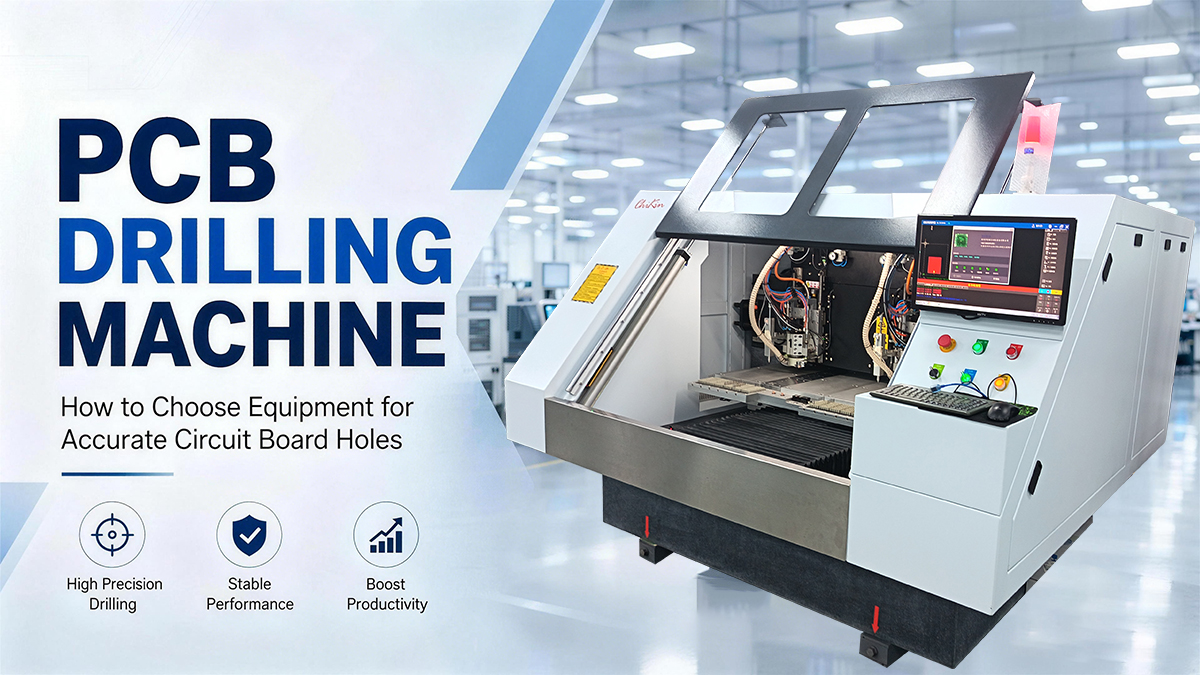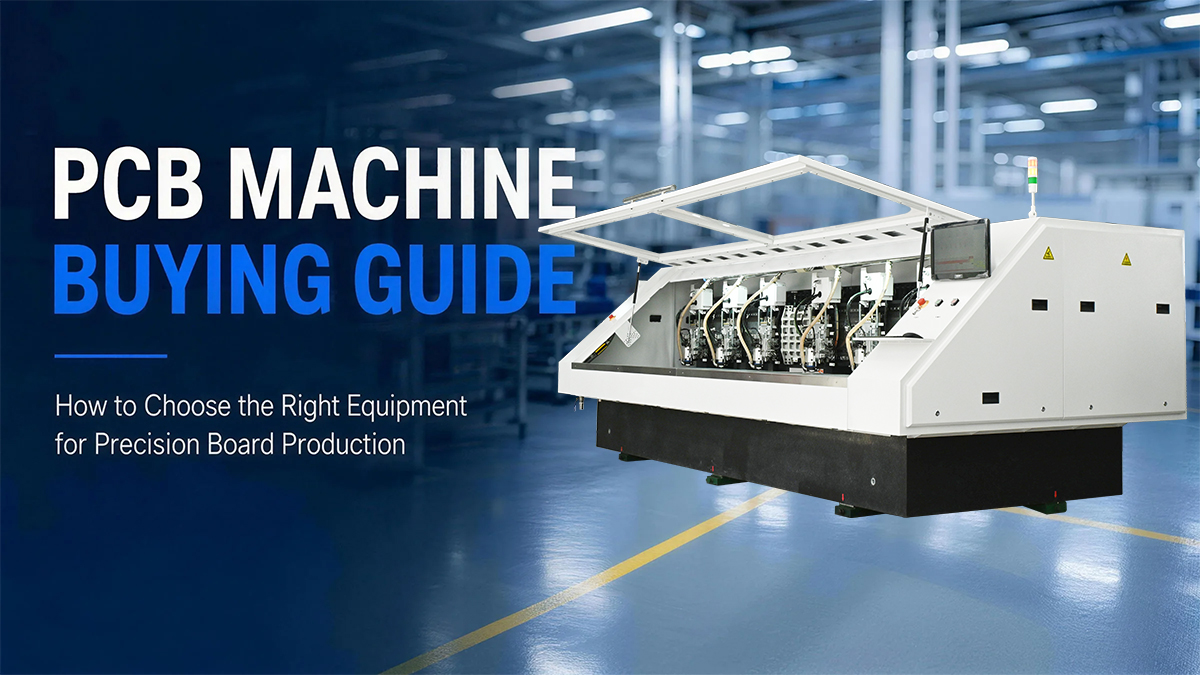




A PCB Machine is a key investment for printed circuit board manufacturers, electronics assembly factories, prototype labs, and industrial equipment buyers. The right machine can improve hole accuracy, routing quality, production speed, inspection efficiency, and long-term output stability.
However, many buyers compare only machine price at the beginning. This can lead to hidden problems later, such as low accuracy, unstable production, difficult maintenance, weak software support, or slow after-sales response.
A better approach is to choose a PCB Machine based on your real production process. Do you need drilling, routing, laser cutting, AOI inspection, IC programming, or a combined CNC solution? What board materials do you process? What accuracy and production volume do you need? These questions should come before the quotation.
This guide explains how to evaluate PCB machines for practical factory use.
What Is a PCB Machine?
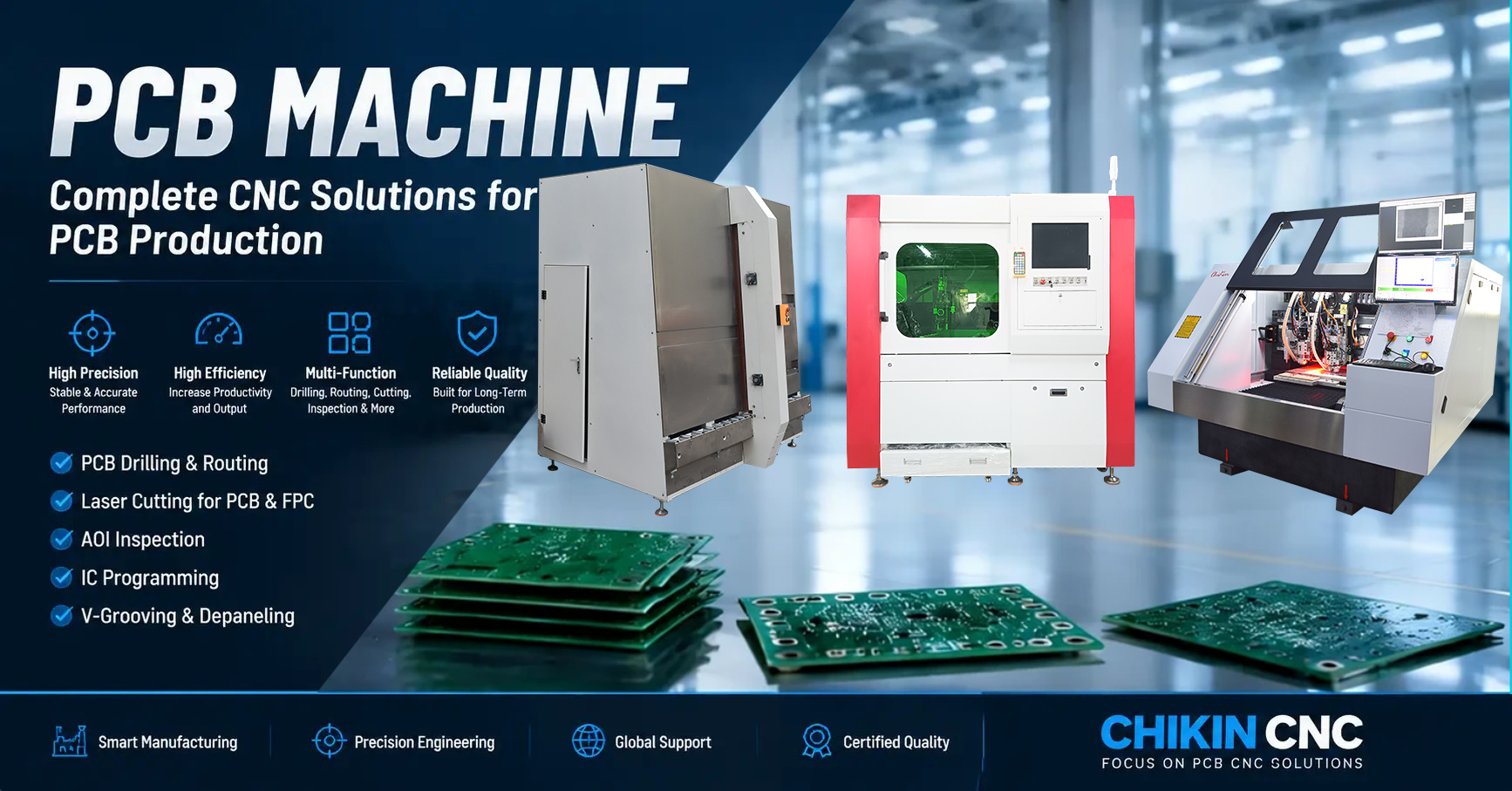
A PCB Machine refers to equipment used in the processing, manufacturing, inspection, or automation of printed circuit boards. Depending on the production stage, it may drill holes, cut outlines, route board profiles, inspect soldering defects, program IC chips, or support panel separation.
Common PCB Machine types include:
- PCB drilling machine
- PCB routing machine
- PCB drilling and routing machine
- PCB laser cutting machine
- FPC UV laser cutting machine
- AOI inspection machine
- Automatic IC programming machine
- PCB V-grooving solution
For modern PCB production, CNC-controlled equipment helps reduce manual errors, improve repeatability, and support stable batch manufacturing.
Main Types of PCB Machines
Different factories need different machines. A prototype lab may care about flexibility, while a high-volume PCB factory may care more about output efficiency and automation.
| PCB Machine Type | Main Function | Best For |
|---|---|---|
| PCB Drilling Machine | Drills vias, through-holes, and tooling holes | FR4, multilayer PCB, prototype boards |
| PCB Routing Machine | Cuts board outlines, slots, and profiles | PCB shaping and depaneling |
| PCB Drilling and Routing Machine | Combines drilling and routing in one system | Factories needing process integration |
| FPC UV Laser Cutting Machine | Non-contact cutting for flexible circuits | FPC, rigid-flex, thin boards |
| AOI Inspection Machine | Detects assembly and soldering defects | SMT and electronics factories |
| IC Programming Machine | Automates chip programming and testing | Electronics assembly workflows |
| V-Grooving Solution | Creates V-cuts for panel separation | Panelized PCB production |
If your main issue is hole accuracy, focus on a PCB drilling machine. If your pain point is board outline quality, a routing machine may be more suitable. If you want to reduce handling between processes, a drilling and routing machine can be a better choice.
Who Needs a PCB Machine?
1. PCB Manufacturers
PCB manufacturers need stable equipment for drilling, routing, cutting, and inspection. Their main concerns include accuracy, cycle time, uptime, board quality, and machine durability.
2. Electronics Assembly Factories
Assembly factories often need AOI inspection and IC programming equipment to reduce manual inspection errors, improve traceability, and increase production consistency.
3. Prototype PCB Labs
Prototype labs need flexible machines for small-batch and fast-changing orders. They usually care about easy setup, compact size, and fast switching between board types.
4. FPC and Rigid-Flex Board Producers
Flexible circuit manufacturers need gentle, accurate processing. For thin or soft materials, UV laser cutting can reduce mechanical stress compared with traditional contact processing.
5. Equipment Distributors
Distributors need a reliable PCB Machine manufacturer that can provide technical documents, stable supply, export support, spare parts, and clear communication for overseas customers.
Key Factors When Choosing a PCB Machine
1. Process Requirement
The first step is to define what process you need to improve. Buying a general machine without process clarity may waste budget.
Ask yourself:
- Do I need drilling, routing, cutting, inspection, or programming?
- Is this machine for prototype production or mass production?
- Do I need one process or a combined solution?
- Will the machine connect with other production steps?
For example, if your factory needs both hole drilling and board outline cutting, a PCB drilling and routing machine may reduce handling and improve workflow efficiency.
2. Accuracy and Repeatability
Accuracy is critical in PCB manufacturing. A small deviation can affect vias, component mounting holes, board alignment, and downstream assembly.
Important accuracy-related factors include:
- Positioning accuracy
- Repeatability
- CCD alignment
- Spindle stability
- Motion system quality
- Fixture and clamping design
- Machine base rigidity
For high-value boards, buyers should not rely only on catalog data. Sample testing is often the best way to confirm real performance.
3. Board Material Compatibility
Different boards require different processing methods. A machine suitable for standard FR4 boards may not be ideal for flexible circuits or metal substrates.
Common board materials include:
- FR4 PCB
- Multilayer PCB
- HDI board
- Rigid-flex PCB
- FPC flexible circuit
- Aluminum PCB
- Copper substrate
- Prototype PCB panels
If you process multiple materials, share the material type, thickness, board size, and production goal with the supplier before selecting a machine.
4. Automation Level
Automation should match production needs. More automation is not always better if your factory mainly handles small custom orders. But for repetitive batch production, automation can reduce labor pressure and improve consistency.
Useful automation features include:
- Automatic tool change
- Broken tool detection
- CCD vision alignment
- Tool length detection
- Automatic loading and unloading options
- Production parameter storage
- Enclosed machine protection
- HMI touchscreen control
For factories planning future expansion, choosing a machine with upgrade potential may protect long-term investment.
5. Software and Operation
Software affects daily production efficiency. A good PCB Machine should be easy for operators to learn and should support practical file handling.
Before buying, ask:
- What file formats can the system support?
- Can production parameters be saved?
- Is operator training provided?
- Can the supplier support remote software troubleshooting?
- Is the interface suitable for your operators?
A machine with strong hardware but difficult software may still slow down production.
6. Quality Control Before Shipment
Professional suppliers should test machines before delivery. Buyers should ask how the machine is inspected and whether sample processing can be arranged.
Recommended checks include:
- Movement test
- Spindle test
- Accuracy verification
- CCD alignment test
- Tool change test
- Sample board processing
- Safety function test
- Packaging inspection
For overseas buyers, video inspection or remote acceptance can also help reduce purchase risk.
PCB Machine Selection Table
| Buyer Situation | Recommended PCB Machine | Reason |
| Need accurate hole drilling | PCB drilling machine | Improves hole position and repeatability |
| Need board outline cutting | PCB routing machine | Supports profile cutting and slot processing |
| Need drilling + routing | PCB drilling and routing machine | Reduces handling and saves floor space |
| Need flexible circuit processing | FPC UV laser cutting machine | Non-contact cutting reduces material stress |
| Need SMT defect inspection | AOI inspection machine | Detects missing parts, misalignment, solder bridges |
| Need chip programming | Automatic IC programming machine | Reduces manual programming errors |
| Need high-volume PCB production | Multi-spindle PCB machine | Improves throughput and cycle efficiency |
Common Mistakes Buyers Should Avoid
Mistake 1: Only Comparing Price
A low-cost PCB Machine may create higher long-term costs if it has poor accuracy, weak structure, unstable software, or limited service support.
Mistake 2: Ignoring Board Type
Board material affects machine configuration. FR4, FPC, aluminum PCB, and rigid-flex boards may require different processing methods.
Mistake 3: Not Considering Future Capacity
If your order volume may increase, choose equipment that can support future expansion. A machine that only meets current demand may become a bottleneck later.
Mistake 4: Skipping Sample Testing
Specifications are useful, but sample testing gives a clearer view of hole quality, routing edge finish, alignment, and operation workflow.
Mistake 5: Overlooking After-Sales Support
PCB equipment requires installation, training, spare parts, software support, and maintenance guidance. For overseas buyers, service response is part of the real machine value.
Why Choose CHIKIN CNC for PCB Machine Solutions?
CHIKIN CNC provides PCB CNC and automation equipment for circuit board manufacturing. Its product range covers PCB drilling machines, PCB routing machines, drilling and routing solutions, FPC/PCB laser cutting machines, AOI inspection machines, automatic IC programming machines, and related PCB production support equipment.
For buyers, CHIKIN CNC can help evaluate:
- Board material and thickness
- Working area and board size
- Drilling or routing accuracy
- Spindle configuration
- CCD alignment requirements
- Automation level
- Production volume
- Machine layout and delivery needs
Instead of simply offering a model list, CHIKIN CNC focuses on matching equipment with actual production requirements.
Learn more about the company:
https://www.chikincnc.com/about-us
View PCB equipment options:
https://www.chikincnc.com/products
Check common service questions:
https://www.chikincnc.com/service/faq
Buyer Checklist Before Requesting a Quote
Before contacting a PCB Machine supplier, prepare the following information:
| Information | Why It Matters |
| Board material | Determines drilling, routing, or laser cutting method |
| Board size | Affects working area selection |
| Board thickness | Influences tooling and machine parameters |
| Minimum hole diameter | Important for drilling configuration |
| Routing profile | Helps evaluate routing machine requirements |
| Production volume | Helps choose single, dual, or multi-spindle options |
| Accuracy target | Determines machine structure and motion system |
| Automation needs | Affects tool change, CCD, and loading options |
| Factory space | Helps plan layout and installation |
| Target budget | Helps match machine performance with investment level |
Providing this information helps the supplier recommend the right PCB Machine instead of giving a generic quotation.
FAQ: PCB Machine
1. What is a PCB Machine used for?
A PCB Machine is used for processing printed circuit boards. It may perform drilling, routing, cutting, inspection, IC programming, or other PCB production tasks depending on the machine type.
2. What is the difference between a PCB drilling machine and a PCB routing machine?
A PCB drilling machine makes holes in the board, while a PCB routing machine cuts board outlines, slots, and profiles.
3. Can one PCB Machine handle both drilling and routing?
Yes. Some PCB drilling and routing machines combine both processes in one system, helping reduce handling steps and improve production efficiency.
4. Which PCB Machine is best for flexible circuits?
For FPC and flexible circuits, a UV laser cutting machine is often suitable because it provides non-contact processing and reduces mechanical stress.
5. What affects PCB Machine price?
Price depends on machine size, spindle configuration, motion system, accuracy level, CCD alignment, automation features, software, and service support.
6. Should I choose a single-spindle or multi-spindle PCB Machine?
Single-spindle machines are suitable for prototypes and small batches. Multi-spindle machines are better for higher production volume and faster cycle time.
7. Why is CCD alignment important?
CCD alignment helps improve registration accuracy by identifying board reference points before drilling or routing.
8. What should I send before asking for a PCB Machine quote?
Send your board material, size, thickness, hole diameter, routing requirement, production volume, accuracy target, and automation needs.
Conclusion: Choose a PCB Machine Based on Real Production Needs
A PCB Machine should be selected according to your actual board type, production process, accuracy requirement, automation level, and long-term service needs. The right machine can improve production consistency, reduce scrap, save labor, and support factory growth.
For PCB manufacturers, electronics factories, prototype labs, and equipment distributors, working with an experienced PCB Machine supplier can reduce selection risk and improve project success.
If you are planning to upgrade your PCB production process, share your board information, production volume, and accuracy requirements with CHIKIN CNC. The team can help recommend a suitable PCB Machine configuration for your factory.
Contact CHIKIN CNC for PCB Machine selection and quotation:
https://www.chikincnc.com/contact-us