



How Can PCB Manufacturers Choose the Right PCB Silk Screen Printing Machine for Stable Production?
In PCB manufacturing, screen printing is often treated as a relatively straightforward process. A screen is prepared, ink is applied, the board is positioned, and the printing stroke transfers the required pattern onto the surface. On a production floor, however, the process is rarely that simple.
When PCB volumes increase, board formats change, registration requirements become tighter, and operators need to repeat the same process for hundreds or thousands of panels, the limitations of manual or poorly configured equipment become much easier to see.
For this reason, selecting a PCB silk screen printing machine is not simply a matter of comparing machine prices or choosing the model with the highest advertised printing speed. For a PCB manufacturer, the more important question is whether the equipment can provide stable registration, consistent printing movement, suitable working dimensions, manageable setup, and reliable operation over repeated production cycles.
This is particularly relevant for buyers evaluating a PCB silk screen printing machine supplier, PCB screen printing equipment manufacturer, or broader PCB manufacturing equipment supplier. The machine itself is only one part of the purchasing decision.The supplier's understanding of PCB production, technical support capability, configuration flexibility, spare-parts availability, and ability to match the machine to the buyer's actual board specifications can have a direct effect on long-term operating costs.
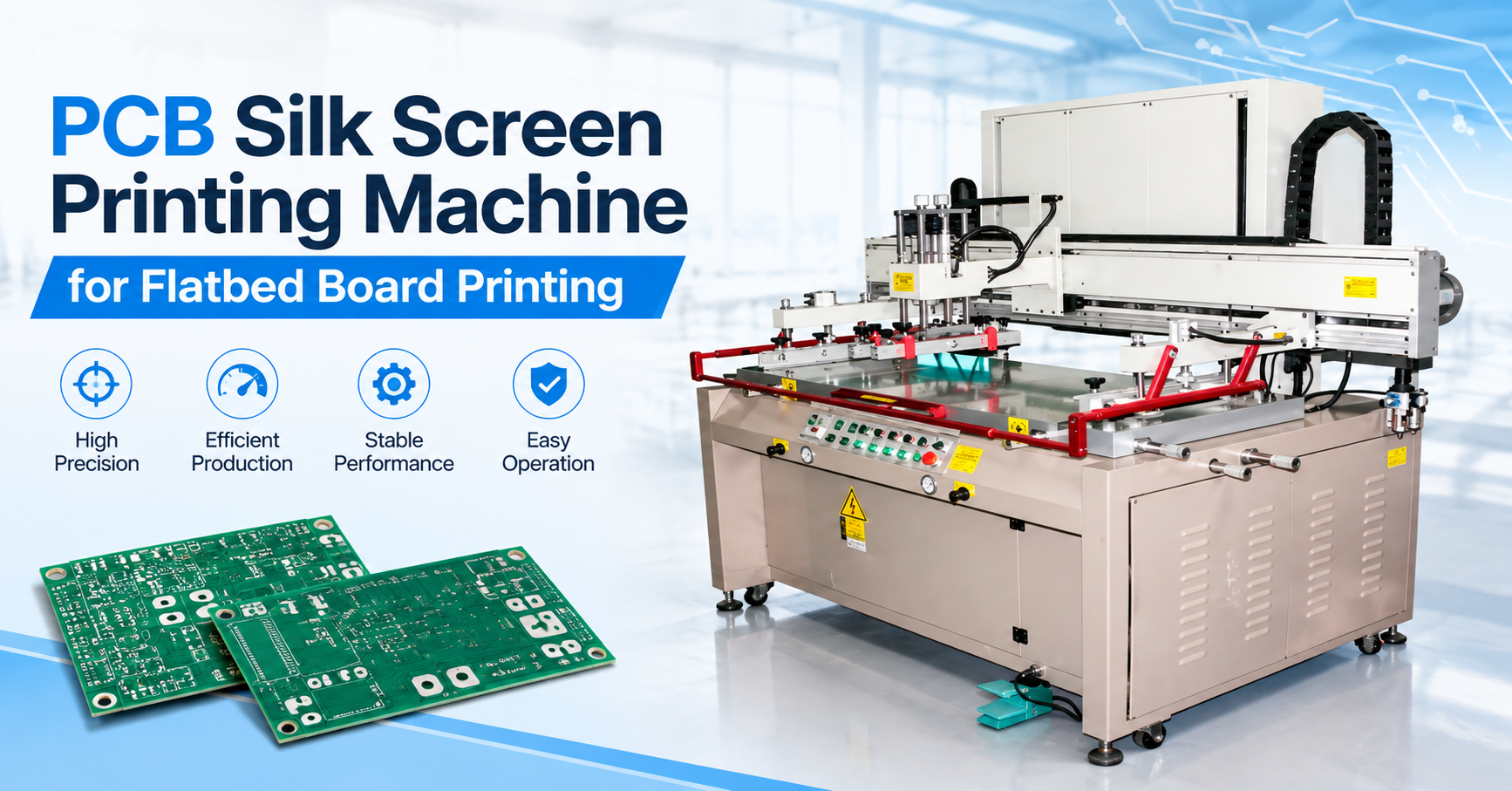
CHIKIN CNC's PCB Silk Screen Printing Machine for Flatbed Board Printing is designed around this production requirement. The product page describes an industrial flatbed screen-printing configuration with a floor-standing cabinet, raised working table, guided printing movement, and operator control interface. The company's published CK-65120 specifications list a 700 × 1450 mm printing table area, 650 × 1200 mm printing area, ±0.05 mm printing accuracy, printing speed up to 600 times/hour, and printed-panel thickness up to 20 mm.
The following guide explains what buyers should look at when choosing this type of equipment, where a production-oriented PCB screen printing machine can provide value, and how to compare suppliers without relying only on marketing claims.
1. Why Does PCB Screen Printing Equipment Matter in Production?
PCB screen printing is used when a controlled amount of ink, paste, coating material, or other printable material needs to be transferred through a screen onto a flat substrate.
Depending on the PCB production process, screen printing may be associated with board markings, legends, coatings, solder-mask-related processes, identification graphics, or other flat-surface printing applications. The exact application depends on the board structure, material, ink system, screen specification, and production workflow.
The basic process appears simple:
- Position the PCB or panel.
- Position and align the screen.
- Apply the required printing material.
- Move the squeegee or printing assembly across the screen.
- Transfer the pattern.
- Remove the board.
- Inspect the printed result.
The difficulty begins when this process must be repeated consistently.
A manual operator may be able to produce acceptable results for a small number of boards. But when production becomes repetitive, differences in board positioning, squeegee movement, pressure, alignment, screen condition, and operator technique can accumulate.
For a PCB factory, those differences can translate into:
- inconsistent registration;
- uneven printed areas;
- additional inspection;
- rework;
- material waste;
- longer setup time;
- increased dependence on operator experience;
- reduced production efficiency.
This is why a PCB printing machine manufacturer should not be evaluated only on whether the equipment can print. The more important issue is whether the equipment can help the factory establish a repeatable process.
2. What Should Buyers Look for in a PCB Silk Screen Printing Machine?
There are several technical factors that deserve attention before a purchasing team requests a quotation.
The most important ones include:
- printing area;
- table dimensions;
- printing accuracy;
- board thickness range;
- screen-frame compatibility;
- adjustment range;
- printing speed;
- machine rigidity;
- movement stability;
- control system;
- ease of setup;
- maintenance requirements;
- power requirements;
- supplier support.
A buyer should first establish the actual production requirement and then compare machines against that requirement.
Buying a larger machine than necessary can increase the investment, footprint, energy consumption, and maintenance burden. Buying a machine that is too small can create a different problem: the factory may have to change its panelization method or operate multiple machines for work that could otherwise be handled by one suitable system.
The right machine is therefore not necessarily the largest or fastest machine.
It is the machine whose working envelope and process characteristics match the factory's actual PCB production.
3. Printing Area Should Be One of the First Specifications to Check
For industrial PCB screen printing, the available printing area is a fundamental specification.
A buyer should distinguish between:
- printing table area;
- effective printing area;
- maximum screen-frame size.
These three dimensions are related but are not identical.
For the CHIKIN CNC CK-65120 configuration, the published specifications list:
| Item | CK-65120 Reference Specification |
|---|---|
| Printing table area | 700 × 1450 mm |
| Printing area | 650 × 1200 mm |
| Printing accuracy | ±0.05 mm |
| Printing speed | 600 times/hour |
| Maximum screen-frame size | 1000 × 1750 mm |
| Screen-frame thickness | 15–40 mm |
| Printed panel thickness | ≤20 mm |
| Fine adjustment | ±10 mm |
| Angle adjustment | 0–45° |
| Power supply | 380V / 50Hz |
| Power consumption | 3.0 kW |
| Machine dimension | 1900 × 1200 × 1750 mm |
| Machine weight | 900 kg |
These are published machine specifications, but the final configuration should still be confirmed with the supplier according to the buyer's actual PCB dimensions, screen, substrate, ink, and process requirements.
This distinction is important.
A buyer may have a panel measuring 600 mm in one direction, for example, and assume that a machine with a 650 mm printing area is automatically suitable. In practice, the screen frame, positioning method, edge clearance, artwork, fixtures, and operator access must also be considered.
For this reason, experienced buyers normally provide the supplier with actual PCB drawings or sample panels before finalizing the machine.
4. Why Is Printing Accuracy Important for PCB Manufacturers?
The phrase "high precision" is widely used in industrial equipment marketing. Buyers should therefore look beyond the phrase itself.
The published CK-65120 specification gives a printing accuracy of ±0.05 mm.
That number is useful, but it should not be interpreted as a guarantee that every PCB application will automatically achieve ±0.05 mm results under every production condition.
Actual printing performance can be affected by:
- board flatness;
- substrate material;
- screen condition;
- screen tension;
- ink characteristics;
- stencil design;
- board positioning;
- machine calibration;
- temperature;
- operator setup;
- maintenance condition.
This is an important point for procurement teams.
A machine's nominal accuracy is only one part of process capability. The complete printing system must be stable enough to reproduce the required pattern consistently.
For a PCB screen printing equipment manufacturer, the ability to discuss these factors with the buyer is often more meaningful than simply repeating a specification sheet.
5. What Does the Flatbed Structure Mean for PCB Production?
The CHIKIN CNC machine is presented as a flatbed PCB screen printing system.
The product page shows a floor-standing industrial machine with a large working surface, raised table structure, control panel, and guided printing assembly.
A flatbed configuration is logical for rigid PCB panels because the substrate can be positioned on a stable horizontal working surface.
From a production perspective, the advantages of this approach include:
Stable substrate positioning
A flat work surface provides a defined reference for positioning the PCB or panel.
Controlled printing movement
The printing head or squeegee assembly moves along a guided path rather than relying entirely on manual movement.
Repeatable production
Once the screen, board position, and printing parameters have been established, the same general process can be repeated for subsequent panels.
Easier production organization
The cabinet-style design creates a dedicated industrial workstation rather than treating screen printing as a temporary manual operation.
The product page specifically describes the machine as an industrial flatbed screen-printing system with a floor-standing cabinet base, raised working table, moving print-head or squeegee assembly, and operator control interface.
6. How Does a PCB Screen Printing Machine Improve Repeatability?
Repeatability is often more valuable than peak speed.
Imagine two factories producing the same PCB panel.
Factory A uses a largely manual printing process. An experienced operator can achieve good results, but different operators may position the board slightly differently or apply different printing conditions.
Factory B uses a dedicated PCB silk screen printing machine with controlled positioning and guided printing movement.
The second factory does not automatically eliminate every printing defect. However, it has a better foundation for standardizing the process.
This difference becomes increasingly important as:
- production volume increases;
- multiple operators share the same process;
- customer specifications become tighter;
- product designs change frequently;
- traceability requirements increase;
- quality-control teams monitor process variation.
The objective is not to remove the operator from the process entirely.
The objective is to reduce unnecessary variation.
That distinction matters when evaluating an automatic PCB screen printing machine or semi-automatic industrial screen-printing system. Automation should be judged according to what part of the process it actually controls.
7. Is Higher Printing Speed Always Better?
Not necessarily.
The CK-65120 is listed with a printing speed of 600 times/hour.
For a procurement team, this figure provides a useful reference when comparing machine configurations. But theoretical printing cycles and actual finished PCB output are not necessarily identical.
Actual production throughput can be affected by:
- loading time;
- unloading time;
- board alignment;
- screen cleaning;
- ink preparation;
- inspection;
- operator handling;
- product changeover;
- curing or drying processes;
- downstream equipment.
A machine may have a high nominal printing speed but still deliver limited real-world output if the upstream or downstream process becomes a bottleneck.
Therefore, buyers should ask suppliers:
What is the expected practical output for our specific PCB panel?
That is a better question than:
What is the maximum machine speed?
8. Why Should Buyers Consider Board Thickness?
The CK-65120 specification lists a maximum printed-panel thickness of ≤20 mm.
This provides a relatively broad mechanical range for a flatbed printing machine, but the buyer should still provide actual substrate information.
PCB manufacturing may involve:
- single-sided boards;
- double-sided boards;
- multilayer boards;
- rigid boards;
- panels;
- special substrates;
- coated surfaces;
- engineering samples.
Different materials can behave differently during printing.
A board that is technically within the thickness limit may still require a particular support or positioning method if it is flexible, warped, unusually heavy, or otherwise different from the standard application.
Therefore, "maximum thickness" should never be the only compatibility criterion.
9. What Is the Importance of Screen-Frame Compatibility?
The screen is a critical component of the printing process.
The machine may be mechanically capable of moving the screen, but the screen itself determines the pattern transfer.
For CK-65120, the published specification lists a maximum screen-frame size of 1000 × 1750 mm and screen-frame thickness of 15–40 mm.
This information should be compared with the buyer's existing screen inventory.
A factory that already operates several screen sizes should check whether the proposed machine can accommodate those screens without unnecessary modifications.
It is also worth considering:
- screen replacement time;
- frame mounting;
- screen alignment;
- tension condition;
- cleaning access;
- storage;
- future screen sizes.
A machine that works well with the factory's existing screen process can reduce the amount of additional infrastructure required after installation.
10. Why Does Machine Rigidity Matter?
Screen printing involves repeated mechanical movement.
The printing head moves.
The squeegee applies pressure.
The screen interacts with the substrate.
The table supports the board.
All of these movements occur repeatedly.
If the machine structure is unstable, mechanical vibration or deformation can influence the consistency of the printing process.
This is why a production-oriented PCB printing machine manufacturer should be able to explain the machine's structural design, not just its software interface.
The CK-65120 is listed with a machine weight of approximately 900 kg, together with overall dimensions of 1900 × 1200 × 1750 mm.
Weight alone does not prove printing quality, but it provides useful context when comparing the machine against lightweight benchtop equipment.
For industrial buyers, the more important question is whether the structure remains stable during repeated production cycles.
11. How Should Buyers Compare a PCB Screen Printer With Manual Screen Printing?
Manual printing still has a place.
For:
- very small quantities;
- experimental work;
- early prototypes;
- irregular products;
- applications where investment must be minimized;
manual equipment may be acceptable.
But once production becomes repetitive, the cost of inconsistency becomes more visible.
A dedicated PCB screen printer provides a more controlled mechanical process.
The advantages can include:
- more consistent movement;
- repeatable positioning;
- easier parameter standardization;
- reduced operator-dependent variation;
- improved production organization;
- better suitability for repetitive manufacturing.
The machine does not remove the need for process control.
The screen still needs to be prepared correctly.
The ink still needs to be suitable.
The PCB still needs to be positioned correctly.
The printing process still needs inspection.
What changes is that the machine creates a more stable mechanical platform around these operations.
12. What Should a Factory Evaluate Before Purchasing?
A good procurement process should begin with the PCB rather than the machine.
Before contacting a PCB silk screen printing machine supplier, prepare the following information:
- maximum PCB size;
- minimum PCB size;
- panel dimensions;
- board thickness;
- substrate type;
- printing purpose;
- ink or paste type;
- screen-frame dimensions;
- target printing accuracy;
- expected production volume;
- required automation level;
- available floor space;
- electrical requirements;
- existing upstream and downstream equipment.
The more complete the information, the easier it is for the supplier to recommend an appropriate configuration.
This also makes quotations easier to compare.
Two suppliers may quote machines that appear similar but have completely different working areas, control systems, screen compatibility, service packages, or production assumptions.
13. How Should Buyers Compare Different PCB Printing Machine Suppliers?
Supplier selection is often more important than buyers initially expect.
A machine is a long-term production asset. It may remain in operation for many years.
The purchasing team should therefore evaluate at least five areas:
1.Manufacturing capability
Does the supplier actually manufacture the equipment?
2. Technical understanding
Can the supplier discuss PCB materials, screen specifications, printing parameters, and production flow?
3. Customization capability
Can the machine be adjusted for the buyer's board size or workflow?
4. Service capability
Can the supplier provide installation, training, spare parts, troubleshooting, and technical support?
5. Long-term supply capability
Can the supplier continue supporting the machine after the initial sale?
A supplier that only focuses on quoting a machine price may not be the best choice for a production line.
14. Direct Manufacturer vs Trading Company: Which Is Better?
This question appears frequently in B2B equipment procurement.
There is no universal rule that every manufacturer is better than every trading company. A trading company may have strong project management capabilities or access to multiple brands.
However, for customized PCB manufacturing equipment, direct communication with the manufacturer can provide practical advantages.
| Purchasing Factor | Direct PCB Machine Manufacturer | General Trading Company |
|---|---|---|
| Technical communication | Usually direct with engineering team | Often depends on upstream supplier |
| Customization | Generally more flexible | Depends on manufacturer |
| Machine knowledge | Detailed | May vary |
| Spare parts | Direct source possible | Additional coordination may be required |
| Troubleshooting | Direct technical channel | May involve an additional intermediary |
| Process consultation | Usually closer to equipment design | Depends on sales team |
| Long-term support | Can be managed by manufacturer | Depends on supplier relationship |
CHIKIN CNC identifies itself as a PCB equipment manufacturer and lists PCB drilling, routing, cutting, imaging, printing, and related production equipment within its product portfolio.
For a buyer, the practical question is therefore not simply whether a company says it is a factory.
Ask for evidence:
- factory information;
- engineering support;
- machine testing;
- product documentation;
- sample testing;
- spare-parts support;
- installation process;
- warranty terms.
15.Why Should Buyers Request Sample Printing Before Ordering?
Sample testing is one of the most useful steps in industrial equipment procurement.
A specification sheet can tell you:
- table size;
- printing area;
- nominal accuracy;
- printing speed;
- board thickness;
- screen size.
It cannot fully demonstrate how your actual PCB will behave.
A sample test can reveal:
- registration behavior;
- ink transfer;
- edge definition;
- board positioning;
- setup time;
- screen compatibility;
- practical printing speed;
- operator workflow.
For this reason, a serious PCB screen printing equipment manufacturer should be able to discuss sample testing when the application requires process validation.
The buyer should ideally provide:
- actual PCB sample;
- screen or screen specifications;
- ink information;
- required printing pattern;
- expected production conditions.
The supplier can then assess whether the machine configuration is suitable.
16. What Are the Most Common Mistakes When Buying PCB Printing Equipment?
Mistake 1: Buying according to price only
The cheapest machine may not be the lowest-cost solution over its operating life.
Maintenance, downtime, spare parts, labor, and inconsistent printing can quickly change the calculation.
Mistake 2: Looking only at maximum speed
Maximum speed does not equal actual factory throughput.
Mistake 3: Ignoring the screen
The screen is a major part of the printing process. Screen size and thickness must be compatible with the machine.
Mistake 4: Ignoring board dimensions
A machine can appear large enough but still have an insufficient effective printing area.
Mistake 5: Treating accuracy as a single number
Printing accuracy depends on the complete process.
Mistake 6: Choosing a machine without considering future products
A machine should ideally support the factory's expected product range rather than only today's most common board.
Mistake 7: Not checking service arrangements
A production machine without reliable technical support can become a significant operational risk.
17. How Does the CHIKIN CNC CK-65120 Fit Into a Production Environment?
The CK-65120 is positioned as a flatbed PCB screen printing machine rather than a small desktop printer.
Its published configuration includes:
- 700 × 1450 mm printing table;
- 650 × 1200 mm printing area;
- ±0.05 mm printing accuracy;
- 600 printing cycles/hour;
- up to 20 mm printed-panel thickness;
- 1000 × 1750 mm maximum screen-frame size;
- 15–40 mm screen-frame thickness;
- ±10 mm table fine adjustment;
- 0–45° angle adjustment;
- 380V / 50Hz power supply;
- 3.0 kW power consumption;
- approximately 900 kg machine weight.
These specifications make the machine more relevant to production environments that need a relatively large flatbed working area and repeatable screen-printing operation.
However, buyers should still confirm the final configuration with CHIKIN CNC before purchase because the suitability of the machine depends on the exact board, screen, ink, and production requirements.
18. What Makes This Machine Relevant for B2B PCB Buyers?
For a B2B buyer, the question is rarely whether a machine can complete one printing cycle.
The real questions are:
Can it do the same job repeatedly?
Can the factory maintain the required registration?
Can operators learn the process without excessive difficulty?
Can the machine fit into the current production line?
Can the supplier support the machine after installation?
This is where an industrial PCB printing machine manufacturer needs to think differently from a seller of generic printing equipment.
PCB factories normally have specific production constraints.
They may need to integrate the printer with:
- PCB preparation;
- drilling;
- routing;
- exposure;
- dry-film lamination;
- coating;
- curing;
- inspection;
- testing;
- panel separation.
Therefore, the printing machine should be considered as one part of the PCB manufacturing workflow.
19.How Should a New PCB Factory Plan Its Printing Equipment?
For a new factory, purchasing equipment too early can create unnecessary restrictions.
The better approach is to define the product mix first.
For example:
Stage 1: Define PCB dimensions
Determine the normal and maximum board sizes.
Stage 2: Define production volume
Estimate daily and monthly output.
Stage 3: Define printing requirements
Clarify whether the process requires:
- legends;
- markings;
- coatings;
- solder-mask-related printing;
- other screen-applied materials.
Stage 4: Define screen specifications
Check screen dimensions and frame thickness.
Stage 5: Define accuracy
Do not simply request "high precision." Give the supplier an actual tolerance requirement.
Stage 6: Define line integration
Determine what equipment comes before and after the printer.
Stage 7: Validate with samples
Use actual PCB samples before placing the final order.
This approach reduces the possibility of purchasing a machine that looks attractive in a quotation but creates problems during production.
20. How Should Existing PCB Factories Upgrade Their Printing Process?
An existing factory has a different challenge.
It already has operators, screens, production methods, and quality-control procedures.
The question becomes:
What is the current bottleneck?
If the problem is inconsistent registration, the factory should examine positioning and printing accuracy.
If the problem is operator dependency, controlled mechanical movement may be more useful.
If the problem is throughput, the factory should examine the complete cycle time rather than just printing speed.
If the problem is product changeover, setup flexibility may be more valuable than maximum output.
This is why a good PCB manufacturing equipment supplier should begin the discussion with the production problem rather than immediately recommending a machine.
21. What Should Be Included in a PCB Printing Machine RFQ?
A professional RFQ should contain enough information for suppliers to quote comparable configurations.
A useful RFQ can include:
| RFQ Item | Information Buyers Should Provide |
|---|---|
| PCB size | Minimum / maximum dimensions |
| Panel size | Actual production panel dimensions |
| Thickness | Normal and maximum thickness |
| Material | FR-4 or other substrate |
| Printing purpose | Marking, legend, coating, etc. |
| Ink | Type and basic properties |
| Screen | Frame size and thickness |
| Accuracy | Required registration/printing tolerance |
| Output | Expected boards or panels per hour |
| Automation | Manual, semi-automatic, or automated requirements |
| Factory power | Available voltage/frequency |
| Floor space | Available installation area |
| Line integration | Upstream/downstream machines |
| Testing | Sample test requirements |
| Service | Installation, training, warranty, spare parts |
A detailed RFQ can also prevent a common B2B problem: comparing two quotations that are not actually based on the same configuration.
22. What Should Buyers Check During Factory Acceptance?
Before shipment, buyers should ideally verify the machine according to an agreed acceptance procedure.
Typical checks can include:
- machine appearance;
- electrical system;
- control interface;
- table movement;
- printing movement;
- screen mounting;
- adjustment functions;
- emergency controls;
- printing accuracy;
- repeatability;
- sample printing;
- accessories;
- documentation.
For a customized machine, the acceptance procedure should be agreed before production.
This is particularly important for international buyers purchasing from a PCB silk screen printing machine supplier overseas.
Clear acceptance criteria reduce misunderstandings between the buyer and manufacturer.
23. What About Maintenance?
A screen printing machine is not maintenance-free.
Regular attention may be required for:
- rails;
- moving components;
- screen supports;
- printing assemblies;
- pneumatic components;
- electrical components;
- table surfaces;
- cleaning areas;
- control components.
Ink residue can also become a practical maintenance issue.
A clean machine is easier to inspect and usually easier to troubleshoot.
For this reason, buyers should ask the supplier for:
- recommended maintenance intervals;
- lubrication requirements;
- common spare parts;
- cleaning procedures;
- troubleshooting documentation;
- recommended consumables.
The machine should be evaluated not only by how it performs on day one, but by how practical it is to maintain after several years of production.
24. How Important Is After-Sales Service?
For industrial equipment, after-sales service should be treated as part of the purchasing decision.
A machine may operate reliably for years, but production equipment eventually requires:
- replacement components;
- troubleshooting;
- software or control support;
- mechanical adjustment;
- operator training;
- process consultation.
CHIKIN CNC's published product information states that the company provides PCB equipment and supports customization and direct equipment inquiries. Its broader product portfolio includes PCB drilling, routing, cutting, imaging, printing, and related equipment.
For international buyers, it is reasonable to ask the supplier how remote support, spare parts, installation, and warranty issues are handled before signing the purchase agreement.
25. Can One PCB Screen Printing Machine Fit Every Factory?
No.
This is an important point.
There is no single screen printing machine that is automatically optimal for every PCB manufacturer.
A prototype factory may prioritize flexibility.
A medium-volume PCB producer may prioritize repeatability and changeover.
A high-volume factory may prioritize cycle time and integration.
A factory producing large panels may need a larger printing area.
Another manufacturer may work primarily with smaller boards and have limited floor space.
The correct selection therefore depends on the production environment.
For the CK-65120, the relatively large published printing area of 650 × 1200 mm makes it particularly relevant to buyers whose panel dimensions require this working range.
But the final decision should always be based on actual production data.
26. A Practical Way to Compare Three Potential Suppliers
Suppose a purchasing team receives quotations from three suppliers.
Supplier A offers the lowest price.
Supplier B offers the highest printing speed.
Supplier C offers detailed technical consultation, sample testing, and a machine configuration that closely matches the factory's PCB panel.
Which supplier should be selected?
The answer should not be decided by price alone.
The team should compare:
Machine capability + process fit + supplier support + total ownership cost.
A low-cost machine that requires frequent adjustment can become expensive.
A very fast machine that cannot handle the buyer's board dimensions is not useful.
A technically appropriate machine supported by a responsive manufacturer may produce the best overall business result, even if its initial quotation is not the lowest.
That is the perspective a B2B procurement team should use.
27. Five Questions Buyers Should Ask a PCB Silk Screen Printing Machine Supplier
Before requesting a final quotation, buyers can ask:
1. What is the effective printing area?
Do not rely only on the overall table dimensions.
2. What printing accuracy can be demonstrated with our sample?
Ask for testing rather than only a specification sheet.
3. What screen-frame sizes are supported?
Confirm compatibility with existing production screens.
4. What is included in the quotation?
Clarify accessories, installation, training, spare parts, and other items.
5. How will technical support be provided after delivery?
This is particularly important for overseas buyers.
28.Procurement FAQ: What Should Buyers Know Before Ordering?
FAQ 1: What is a PCB silk screen printing machine used for?
A PCB silk screen printing machine is designed to transfer ink, paste, coating, markings, legends, or other printable materials onto flat boards or panels through a screen-printing process. The exact application depends on the PCB production method, ink system, screen, and required pattern.
The CHIKIN CNC product is positioned as a flatbed board-printing machine for controlled and repeatable printing applications.
FAQ 2: What is the printing area of the CHIKIN CNC CK-65120?
The published CK-65120 specifications list a 700 × 1450 mm printing table area and a 650 × 1200 mm printing area.
The buyer should still confirm the final usable area based on the actual PCB dimensions and screen configuration.
FAQ 3: What is the printing accuracy?
The published specification for the CK-65120 lists ±0.05 mm printing accuracy.
Actual production performance depends on the PCB material, screen, ink, alignment, machine setup, and process conditions, so sample testing is recommended for applications with strict requirements.
FAQ 4: How fast can the machine print?
The published CK-65120 specification lists a printing speed of 600 times/hour.
This should be treated as a machine-cycle reference rather than a guaranteed finished-PCB production rate. Loading, alignment, inspection, cleaning, changeover, and downstream processes can affect actual output.
FAQ 5: Should I choose a PCB screen printing machine manufacturer or a trading company?
Both models can serve industrial buyers, but direct communication with a manufacturer can be useful when the project requires customization, sample testing, engineering discussion, spare parts, or long-term technical support.
The most important point is to verify the supplier's actual manufacturing and service capabilities rather than relying only on its company description.
29.Final Buyer Checklist
Before placing an order for a PCB silk screen printing machine,a factory should ideally confirm all of the following:
Machine
-
Printing area matches PCB dimensions
-
Table size is suitable
-
Board thickness is within range
-
Screen-frame size is compatible
-
Printing accuracy meets the application
-
Printing speed matches production requirements
-
Machine footprint fits the factory
-
Electrical requirements are compatible
Process
-
PCB material has been confirmed
-
Ink type has been confirmed
-
Screen specification has been confirmed
-
Registration requirements have been defined
-
Actual samples have been tested
-
Practical production cycle has been evaluated
Supplier
-
Manufacturer capability has been checked
-
Engineering support is available
-
Spare-parts policy is clear
-
Installation and training are defined
-
Warranty terms are clear
-
After-sales communication is established
Commercial
-
Machine price is clearly defined
-
Accessories are listed
-
Packaging is specified
-
Delivery time is confirmed
-
Payment terms are clear
-
Acceptance criteria are agreed
Conclusion: Is the Right PCB Printing Machine Really About Speed and Price?
For PCB manufacturers, choosing a PCB silk screen printing machine should be approached as a process-engineering decision rather than a simple equipment purchase.
Printing speed matters, but it is only one variable.
A more useful evaluation considers the entire production system:
printing area + accuracy + repeatability + screen compatibility + board compatibility + machine stability + operator workflow + supplier support.
The CHIKIN CNC CK-65120 provides a production-oriented flatbed configuration with a published 650 × 1200 mm printing area, ±0.05 mm printing accuracy, 600 printing cycles/hour, and support for printed panels up to 20 mm thick. Its published configuration also includes a 700 × 1450 mm printing table, ±10 mm fine adjustment, 0–45° angle adjustment, and compatibility with screen frames up to 1000 × 1750 mm.
These specifications give buyers a concrete basis for comparison, but they should not replace application testing.
For a PCB factory, the best machine is not necessarily the one with the biggest table, fastest cycle, or lowest initial price. It is the one that can be integrated into the existing production process and deliver the required result repeatedly without creating unnecessary maintenance or operational problems.
That is also why supplier selection matters.
A capable PCB silk screen printing machine supplier should be able to discuss more than the machine itself.The supplier should understand board dimensions, screen requirements, printing materials, accuracy expectations, production volume, workflow integration, installation, maintenance, and long-term technical support.
For buyers evaluating PCB screen printing equipment, PCB printing machine manufacturers, or a complete PCB manufacturing equipment supplier, the most reliable purchasing method is straightforward:
Define the PCB process first. Compare the machine second. Verify the result with samples. Then evaluate the supplier's long-term ability to support the equipment.
That approach may take more time during procurement, but it can significantly reduce the risk of choosing equipment that looks attractive on paper and performs differently on the production floor.
For the CHIKIN CNC PCB Silk Screen Printing Machine, buyers should provide their PCB dimensions, panel size, board thickness, screen-frame information, printing material, target output, and accuracy requirements so the final machine configuration can be evaluated against the actual production application.
Recommended B2B keywords naturally covered in this article:
PCB silk screen printing machine, PCB silk screen printing machine supplier, PCB screen printing equipment manufacturer, PCB printing machine manufacturer, PCB manufacturing equipment supplier, PCB screen printer, automatic PCB screen printing machine, industrial PCB printing equipment, PCB printing equipment, and PCB production line equipment.