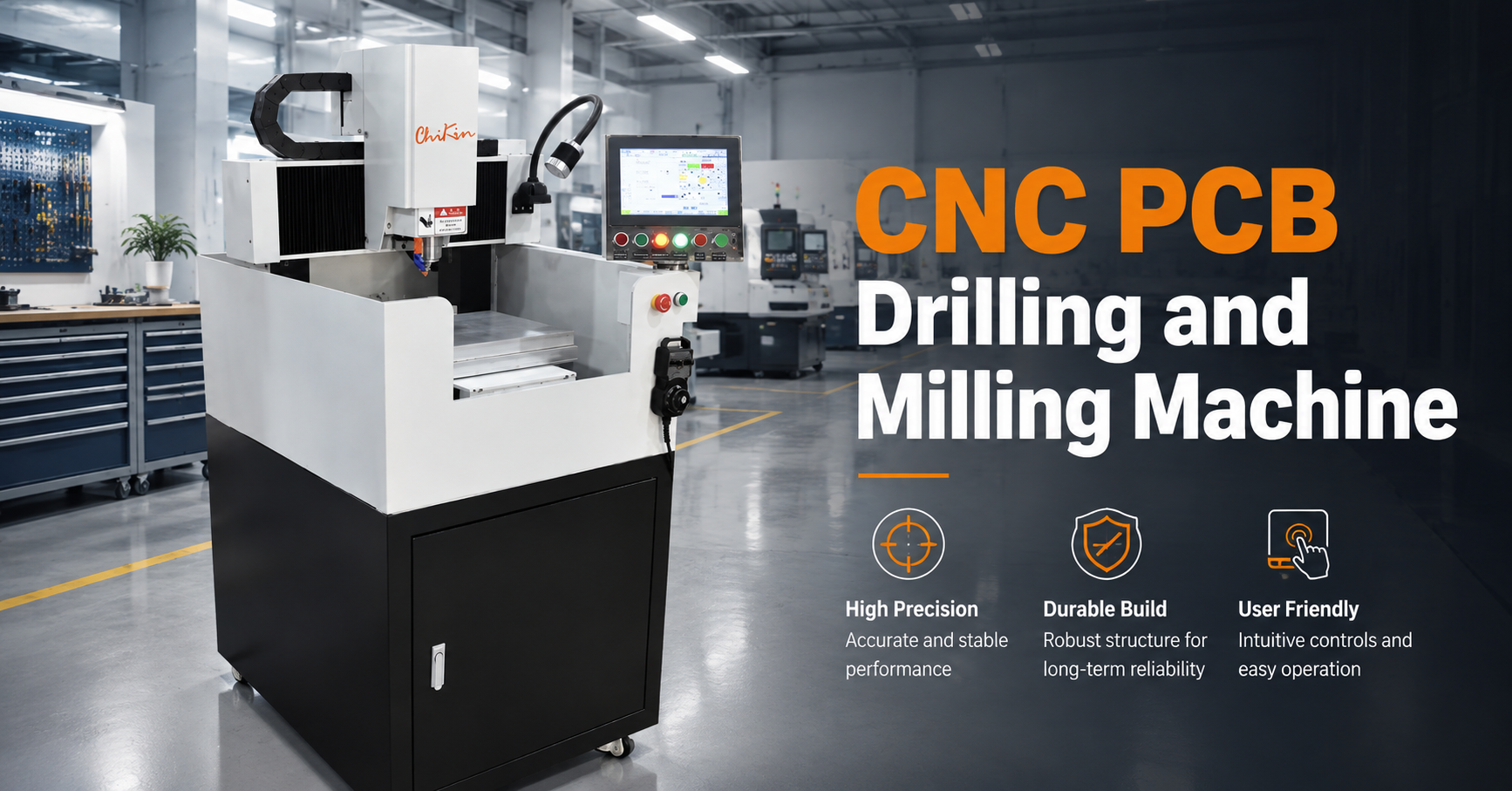




A useful PCB routing machine price cannot be separated from the production job. A base machine may look inexpensive, yet the final working cell also depends on spindle count, routing area, tooling, dust extraction, vision, automation, installation, and support. The right comparison is therefore not "machine A versus machine B." It is "quote A and quote B for the same board, output target, and acceptance conditions."
This guide shows purchasing and process teams how to build that comparison. It does not give a generic price range because a number without the process scope would be misleading. Instead, it explains what changes the quote, which recurring costs are easy to miss, and what data a supplier needs before issuing a production-ready proposal.
What determines PCB routing machine price?
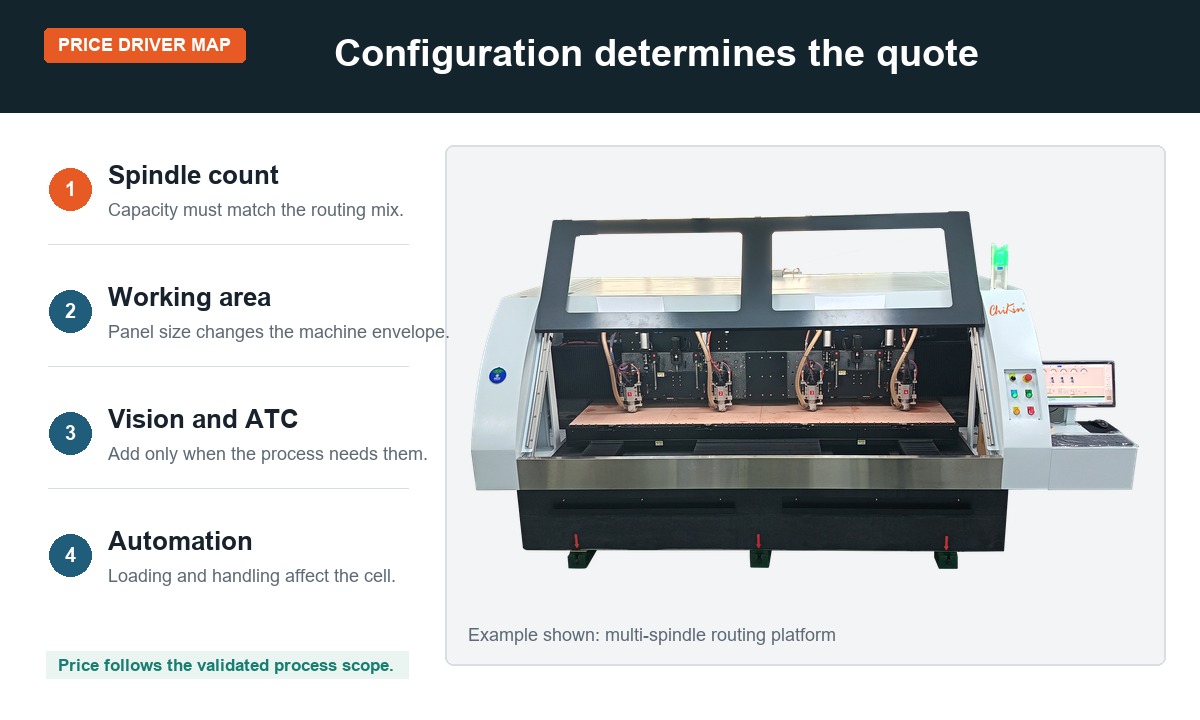
The largest price differences usually come from configuration, not from the label on the quotation. Two machines may both be described as PCB routers while differing in useful working area, spindle arrangement, tool handling, dust collection, software, inspection functions, and installation scope.
Seven items deserve an early check:
- Board and panel format: material, thickness, panel size, outline, slot geometry, and fixture method.
- Output requirement: product mix, shift pattern, changeover frequency, and required panels per shift.
- Spindle arrangement: single spindle, parallel multi-spindle, or separate drilling and routing spindles.
- Tool management: manual or automatic tool change, tool measurement, tool-life tracking, and breakage checks where required.
- Registration: fixture-based positioning, camera recognition, fiducial alignment, or another agreed locating method.
- Dust control: pickup design, ducting, extraction unit, filtration, cleaning access, and disposal plan.
- Delivery scope: freight, installation, training, sample validation, acceptance support, spare parts, and service.
That is why a headline PCB router machine price can be a poor purchasing shortcut. Unless every supplier is pricing the same scope, the lowest total on the first page may simply contain more exclusions.
Why should the RFQ start with board and output data?
Start with the part, not the machine model. The board tells the supplier how much travel, spindle capability, tooling access, fixture space, and dust control the process may need. The output plan tells the supplier whether one working position is enough or whether parallel machining deserves consideration.
| RFQ input | Why it matters | What can change in the quote |
|---|---|---|
| Board material and thickness | Affects routing resistance, dust, tool choice, and holding method | Spindle, tooling, extraction, fixture |
| Panel dimensions | Defines usable travel and loading clearance | Machine size, table, enclosure |
| Outline and minimum slot | Shows contour length, corners, narrow features, and tool access | Tool diameter, routing strategy, cycle assumptions |
| Target output | Connects machine layout to the required production pace | Spindle count, handling, automation |
| Gerber or ODB++ files | Allows the process to be reviewed against actual geometry | Programming, tooling, fixture, validation work |
| Factory location and voltage | Clarifies power, shipping, installation, and service planning | Electrical configuration and delivery scope |
How does single-spindle versus multi-spindle configuration affect cost?
A single-spindle platform is often the cleanest starting point for prototypes, repair work, product development, frequent changeovers, and production where one spindle can meet the planned load. It can also make process debugging easier because the engineer is managing one routing position and one tool path at a time. The important test is capacity, not whether the machine has fewer features.
A multi-spindle platform can process matching work in parallel when the panel layout, fixture, routing program, and production mix support that arrangement. The purchase price may be higher, but spindle count alone does not prove better economics. If jobs rarely fill all working positions, or if the product mix changes constantly, available capacity may sit unused. Ask the supplier to show the cycle-time assumptions and loading pattern behind the recommendation.
A combined drilling and routing arrangement is another option when a part needs both processes and the production plan benefits from keeping them on one platform. A vision-assisted configuration may help when the locating strategy relies on marks or features rather than only a fixed fixture. Both choices should be confirmed with actual board data and sample validation.
Routing platforms to review
| Platform | Typical buying question | Product page |
|---|---|---|
| Single spindle | Can one routing position meet the output and changeover plan? | Review the single-spindle drilling and routing machine |
| Two spindle | Can matching work be routed in parallel without adding handling delay? | Review the two-spindle PCB routing platform |
| Four spindle | Does stable, repeated work justify additional parallel capacity? | Review the four-spindle PCB routing platform |
| One drill plus one route spindle with CCD | Would separate processes and camera-assisted alignment simplify the job? | Review the CCD drilling and routing configuration |
These pages show configuration directions, not an automatic selection. A sample board, routing file, capacity review, and acceptance plan should decide the final model.
How do tooling and consumables change the real cost?
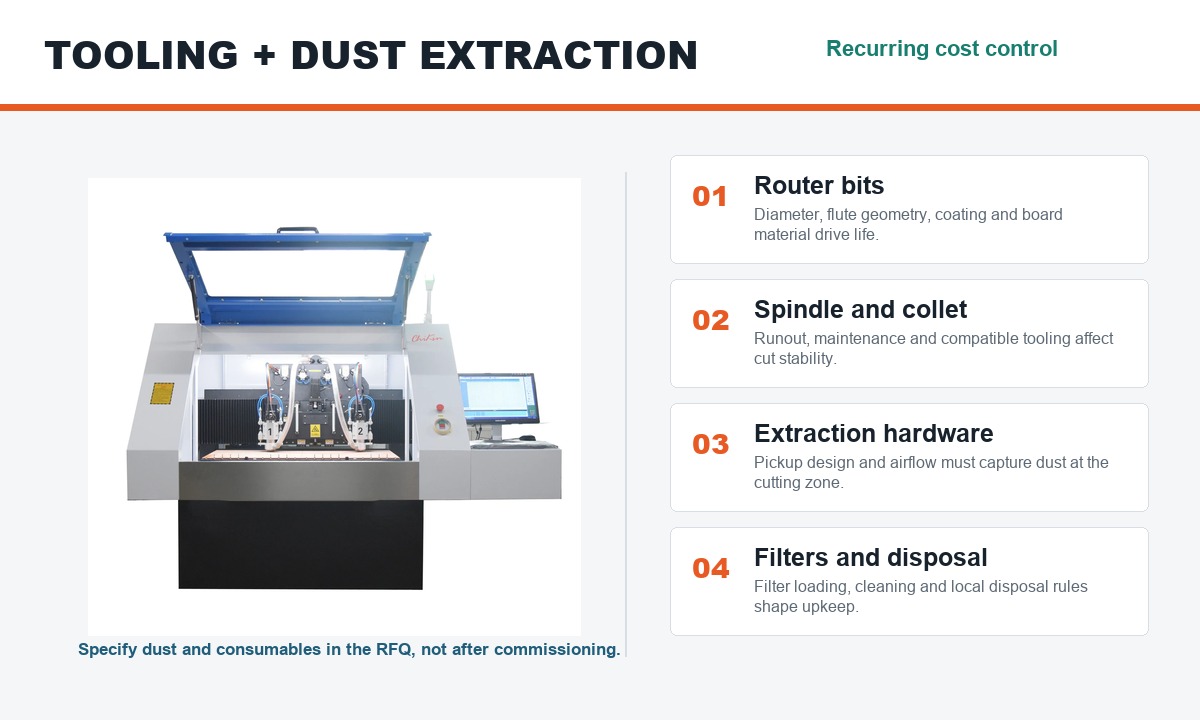
The purchase order is paid once. Router bits, filters, collet care, and maintenance continue for as long as the machine runs. For many factories, this is where an apparently small difference in PCB milling machine price becomes less important than process stability and consumable control.
Tool cost should be estimated by accepted production, not by the price of one bit. The useful calculation is:
Routing tool cost per accepted panel = total routing tool spend / accepted panels produced
To make that figure meaningful, record the tool diameter, tool geometry, board material, routed length, spindle condition, programmed feed, number of panels completed, and reason for tool replacement. A tool removed on a fixed schedule is different from one removed after wear, breakage, or a quality alarm. Mixing those records hides the real cause of consumption.
Also check how the quotation handles collets, tool holders, tool detection, spare sensors, and starter tooling. If an automatic tool changer is included, ask how many tools it holds, how tool offsets are established, and what happens when a tool is missing or outside the agreed condition. If tool change is manual, include operator time and the possibility of a longer stop in the capacity model.
What dust extraction should be included in the quote?
PCB routing creates dust at the cutting zone. The extraction scope must therefore be treated as production equipment, not as a late accessory. A complete discussion covers the pickup point, hoses and ducting, required airflow at the machine, extraction unit, filters, cleaning access, collection container, noise, replacement parts, and the factory's disposal procedure.
Do not compare only motor power or a catalog airflow number. The path from the router bit to the collector matters. Long ducts, tight bends, leakage, poor pickup geometry, and loaded filters can change what happens at the cutting point. Ask each supplier to state exactly which parts are included and which utilities or external equipment the buyer must provide.
Board materials and local workplace rules may also change the required filtration and handling method. The machine supplier can describe the equipment interface, but the factory's environmental, health, and safety team should approve the final arrangement for the actual materials being processed.
When do vision, software, ATC, and automation justify their cost?
Options should remove a defined production constraint. Buying every available feature raises the initial PCB CNC router cost and can add maintenance work. Leaving out a required function can create a different expense through manual alignment, repeated setup, extra handling, or longer stops. The decision is strongest when each option is tied to a measurable task.
| Option | Consider it when | Ask the supplier |
|---|---|---|
| CCD or vision alignment | Registration depends on visible marks or board features | Which features are recognized, and how is offset handled? |
| Automatic tool change | Programs need several tools or manual changes interrupt production | What is included for storage, measurement, and error handling? |
| Tool inspection | The process needs checks for length, diameter, or breakage | Which checks are available on the quoted model and how are alarms recorded? |
| Loading and unloading | Handling is a proven bottleneck on stable, repeat work | What board range, buffers, interfaces, and recovery steps are included? |
| Production data connection | Traceability or factory-system integration is required | Which data, protocol, and integration responsibilities are in scope? |
One practical rule helps: if the team cannot describe the problem an option solves, the option is not ready for approval. Run the job manually or with a simpler setup first, measure the constraint, and then price the upgrade against that evidence.
Which installation, training, and service costs belong in TCO?
A machine on the factory floor is not yet an accepted process. The budget should cover the steps between delivery and stable production. Depending on the project, that can include unloading, positioning, utilities, extraction connection, software setup, fixture preparation, sample runs, operator training, maintenance training, spare parts, travel, and acceptance support.
Service language on a quotation should be specific. "Installation included" may still leave travel, local transport, accommodation, utilities, or translation outside the price. "Remote support" should state the communication method, operating hours, information the buyer must provide, and when onsite work becomes necessary. Warranty terms should identify the period, covered parts, exclusions, shipping responsibility, and the process for confirming a fault.
For an overseas project, add electrical requirements, installation country, site access, local lifting arrangements, and the planned production date to the RFQ. ChiKin describes a service process that can include equipment selection, technical documentation, installation guidance, training, and after-sales support. Confirm the exact scope for the proposed configuration on the one-stop service page and project quotation.
How should buyers calculate total cost of ownership?
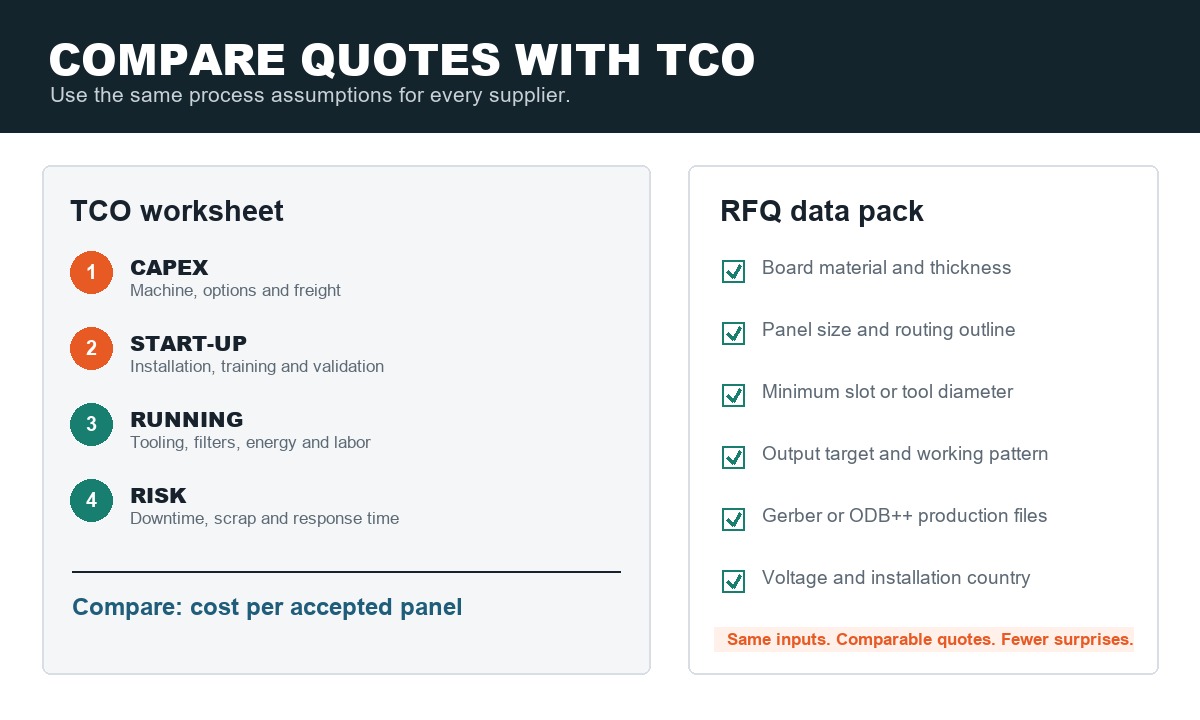
Total cost of ownership is useful only when the period and production assumptions are written down. Pick an evaluation period, use the same shift plan for every quote, and separate known costs from estimates. Where a value is uncertain, use a range and identify the owner responsible for confirming it.
TCO = capital cost + start-up cost + recurring operating cost + production-risk cost - residual value
| TCO group | Items to include | Evidence to request |
|---|---|---|
| Capital | Machine, options, fixture, extraction, freight, tax where applicable | Itemized commercial quotation |
| Start-up | Installation, training, validation, initial tooling, spare parts | Scope of work and acceptance plan |
| Recurring | Tools, filters, energy, compressed air, labor, maintenance | Consumption assumptions and maintenance schedule |
| Production risk | Downtime, scrap, rework, slow changeover, delayed service | Test results, response process, spare-parts plan |
Then normalize the result:
Estimated cost per accepted panel = TCO for the evaluation period / accepted panels in that period
Use accepted panels, not attempted panels. This keeps scrap and rework visible. Do not treat the calculation as a guaranteed ROI claim; it is a decision model built from agreed assumptions. Update it after sample testing and again after commissioning with real production records.
How can you compare PCB routing machine quotations fairly?
- Freeze the input pack. Send the same board files, materials, panel dimensions, target output, utilities, and installation location to each supplier.
- Request an itemized scope. Separate the base machine, options, fixture, extraction, tooling, freight, installation, training, and spares.
- Record exclusions. A blank field is not automatically included. Ask who provides ducting, transformer, compressor, computer, fixture, lifting, and local labor.
- Review cycle assumptions. Confirm tool path, number of boards processed together, loading time, tool changes, and expected utilization.
- Plan a sample test. Agree on the test files, material, quantity, inspection method, and acceptance criteria before the run.
- Check service boundaries. Compare training days, remote support, onsite terms, spare-parts supply, warranty wording, and fault-confirmation procedure.
- Calculate one TCO model. Apply the same period, labor assumptions, consumable logic, and accepted output to every quotation.
This process will not force every supplier into the same machine design. It does make differences visible, which is the point. A more expensive proposal may include work another quote leaves to the buyer. A lower proposal may be entirely suitable when the process is simpler.
When can a lower-priced PCB router be the right choice?
A lower-priced machine can make sense when the board range is narrow, output is moderate, loading can remain manual, one spindle meets demand, the fixture provides reliable positioning, tool changes are infrequent, and local staff can support routine maintenance. Prototype labs, engineering departments, and small-batch production may value flexibility more than maximum parallel capacity.
The risk appears when the price is reduced by removing something the process actually needs. A small working area may require extra setups. Manual alignment may be unsuitable for the locating method. An underspecified extraction system may shift cost to the factory. Limited service scope may be acceptable for an experienced team but difficult for a first-time user.
So the question is not "Is the cheapest machine good?" Ask, "What production assumption allows this configuration to be simpler?" If the supplier and the buyer can answer that with the same board data, the decision has a sound basis.
What should you send for a production-ready quote?
Send the following information with your inquiry:
- Board material and thickness
- Panel size and the usable routing area
- Routing outline, contour length, and minimum slot or tool diameter
- Target output per shift or per day
- Product mix and expected changeover frequency
- Gerber, ODB++, DXF, drill, or routing files available for review
- Required locating method, including fiducials or other marks if relevant
- Factory voltage, frequency, and compressed-air availability
- Installation country, delivery terms, and requested support scope
Need a configuration and quotation? Review ChiKin's PCB drilling and routing machine range, then send the engineering data above. The reply can focus on the routing platform, tooling, dust extraction, options, validation plan, and service scope that fit your production task rather than a generic catalog price.
Frequently asked questions
Why do suppliers avoid listing one fixed PCB routing machine price?
Because working area, spindle count, tool handling, vision, extraction, automation, delivery, and service can change the scope. A fixed number may describe a base unit but not the production-ready cell required for a specific board.
Is a multi-spindle PCB router always more cost-effective?
No. It is attractive when the work can run in parallel and the production load uses the available positions. For frequent changeovers, mixed products, or moderate output, a single-spindle arrangement may be easier to justify.
Should dust extraction be quoted with the machine?
Yes. At minimum, the RFQ should define the machine pickup interface, ducting responsibility, extraction unit, filters, replacement parts, and site requirements. The final system must also match the processed material and local factory rules.
How can I estimate routing tool cost?
Track total tool spend against accepted panels, then record board material, routed length, tool specification, programmed process, spindle condition, and replacement reason. This is more useful than comparing the unit price of a router bit alone.
What files are best for a quotation?
Gerber or ODB++ data is useful, along with the routing or mechanical layer, panel drawing, material and thickness, minimum slot, output target, and any fixture or fiducial requirements. Ask the supplier which additional files are needed for sample validation.
What is the best way to compare two quotes?
Give both suppliers the same input pack, request itemized inclusions and exclusions, agree on the same sample test, and calculate TCO over the same period. Compare estimated cost per accepted panel as well as the initial purchase price.