



Why Better Dry Film Lamination Can Decide the Stability of Your PCB Imaging Process
In PCB manufacturing, dry film lamination is one of those process steps that looks simple from a distance but quickly becomes critical when defects appear. A roll of dry film photoresist must be transferred onto a prepared copper surface. The film has to lie flat, stay aligned, and bond evenly. If the film wrinkles, traps air, shifts during feeding, or receives uneven pressure, the problem does not stop at the laminator. It may continue into exposure, developing, etching, inspection, and final yield.
That is why choosing the right PCB dry film lamination machine matters for PCB factories, prototype workshops, and contract manufacturers. Chikin CNC describes this machine as equipment built for one of the most delicate steps in printed circuit board production: placing dry film photoresist onto a prepared copper surface without wrinkles, bubbles, or uneven pressure marks. The product page also states that defects at the lamination stage can affect downstream imaging and etching, so the machine’s job is to keep the film path stable, controlled, and repeatable.
For B2B buyers searching for a dry film laminator, photoresist laminating machine, PCB dry film applicator, or PCB lamination equipment, the purchasing decision should not begin with price alone. A better starting point is the real process problem: can the machine guide thin film smoothly, maintain steady roller contact, reduce bubbles and wrinkles, and support consistent photoresist transfer across batches?
A dry film laminator is not just a roller machine. In PCB production, it becomes part of the imaging preparation chain.
Why Is Dry Film Lamination So Important Before PCB Imaging?
Dry film photoresist is used to form a protected image layer before later PCB processes such as exposure, developing, and etching. If lamination is unstable, even a good exposure machine may struggle to deliver consistent results. Poor film contact can create defects that appear later as broken lines, incomplete image transfer, under-etched or over-etched areas, rework, or scrap.
Chikin’s product page explains that the PCB dry film lamination machine is designed to keep the film path stable and controlled. It also states that buyers benefit from fewer reworks, cleaner board surfaces, and more consistent transfer of the photoresist layer across production batches.
This is a practical point for factory buyers. Lamination quality affects the reliability of the next process. If the film is not applied smoothly, later steps may reveal problems that are expensive to trace back. The production team may blame exposure or etching, when the root cause began at film transfer.
A stable PCB photoresist film laminator helps reduce these risks by giving the factory a more controlled way to move, guide, press, and align the film. It does not remove the need for clean copper surfaces or correct process settings. But it helps make one sensitive operation more repeatable.
What Does a PCB Dry Film Lamination Machine Do?
A PCB dry film lamination machine applies dry film photoresist onto a prepared copper-clad board or similar substrate. The process typically involves feeding dry film from roll stock, guiding it through rollers, aligning it with the board surface, and pressing it into contact under controlled conditions.
Chikin CNC describes this machine as a dry film laminator or photoresist laminating machine that supports roll-fed processing of flexible sheet material. The product page states that, in PCB dry film processing, the dry film must lie flat on the board surface before bonding and subsequent exposure. It also notes that trapped air, alignment drift, or unstable feed tension can create costly defects.
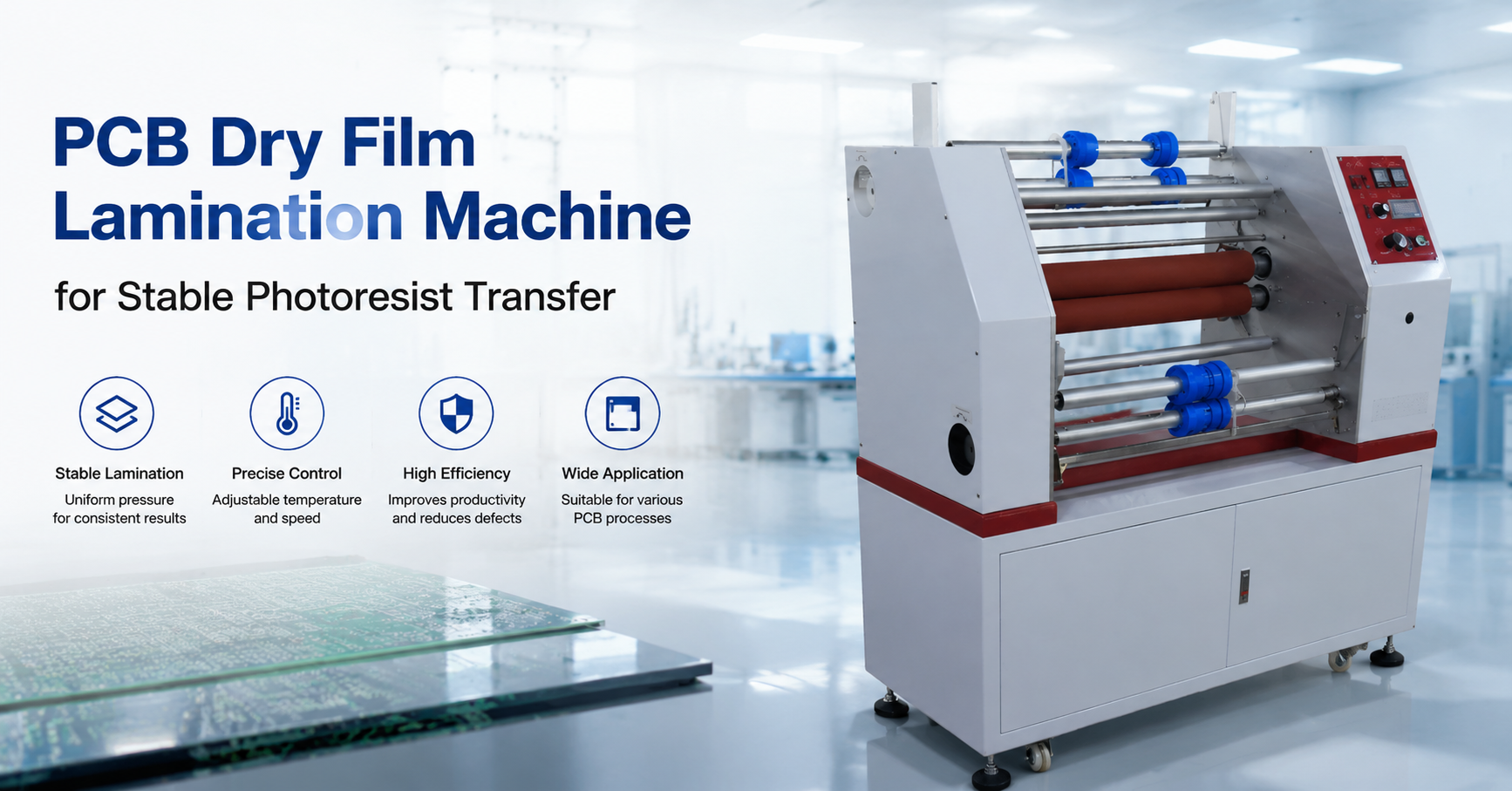
The visible structure on the product page suggests an industrial roll-processing platform. Chikin describes multiple rollers, an enclosed cabinet base, and a powered drive section, indicating a machine designed to move material smoothly through a controlled contact zone. The page also states that this kind of setup is valuable wherever a thin film must be guided, pressed, or aligned with care.
This means the machine should be evaluated as a web-handling and contact-control system, not only as a simple press.
What Product Features Should Buyers Notice?
The product page does not provide a complete readable numerical specification table, so buyers should not assume confirmed roller width, speed range, temperature range, pressure range, or electrical details. However, the page gives useful information about visible structure and process logic.
| Product / Process Feature | Information from Chikin Product Page | Why It Matters for PCB Buyers |
|---|---|---|
| Main function | Places dry film photoresist onto prepared copper surfaces | Supports PCB imaging preparation before exposure and etching |
| Process goal | Reduce wrinkles, bubbles, uneven pressure marks, and unstable transfer | Helps lower rework and improve consistency across batches |
| Multi-roller web path | Multiple horizontal rollers indicate guidance, tensioning, and pressing functions | Helps control film movement and contact quality |
| Roll-fed material handling | Supports roll-fed processing of flexible sheet material | Suitable for dry film photoresist and similar thin web materials |
| Enclosed cabinet base | Machine has an enclosed steel cabinet base and front service area | Supports cleaner installation and internal component protection |
| Powered drive section | Motorized drive component is visible on the lower section | Suggests controlled material movement rather than manual feeding |
| Right-side control panel | Includes display, switches, indicator lights, and rotary knob | May support operation adjustment, but exact functions must be confirmed |
| Roller material variation | Some rollers appear coated while others are polished metal | Different roller surfaces may support guiding, gripping, or pressure contact |
| Floor placement | Casters or leveling feet are visible | Helps with machine positioning and stable installation |
| Customization points | Roller diameter, roller surface type, control layout, feed direction, cabinet dimensions, and line integration should be clarified | Helps match the machine to board size, film type, and production layout |
These points show the machine’s main value: controlled film transfer through a structured roller path.
Why Does the Multi-Roller Web Path Matter?
A dry film laminator depends heavily on how the film travels through the machine. Thin film can wrinkle, stretch, wander, trap air, or pick up defects if the path is poorly controlled. Chikin’s product page states that the visible multi-roller arrangement suggests guidance, tensioning, and pressing functions. It also notes that some rollers appear rubberized or coated while others are polished metal guide rollers, which is common in web-handling equipment because different roller surfaces serve different roles.
For buyers, the roller path should be one of the main selection points. A machine with weak guiding or poor roller alignment may cause film wander. A machine with uneven roller contact may create pressure marks. A machine with unsuitable roller surfaces may scratch, stretch, or contaminate film.
A professional PCB dry film applicator should control the film path from entry to contact point. The film should move smoothly, contact the board evenly, and stay stable enough for repeat production. The buyer should ask the supplier how the roller system manages alignment, tension, pressure, and surface protection.
Why Is Roller Surface Condition Important?
Chikin’s page states that, if the unit is configured for photoresist film laminator use, the roller surface condition matters greatly. A clean, consistent roller face helps reduce scratches and uneven lamination lines, especially when processing thin films that can easily crease or stretch. The page also says exact roller material cannot be confirmed from the image, so buyers should ask for the actual roller specification before ordering.
This is a critical buying point. In dry film lamination, the roller is not only a mechanical part. It directly affects the film surface and bonding uniformity. Any damage, dirt, flat spot, poor coating, or inconsistent hardness may appear as a process defect.
Before choosing a photoresist laminating machine, buyers should ask:
What roller material is used?
Which rollers are coated and which are metal guide rollers?
How is roller runout controlled?
How should rollers be cleaned?
How often should roller surfaces be inspected?
Can roller pressure be adjusted?
Can roller hardness or covering be customized?
What happens if the film is easily scratched or stretched?
These questions are not excessive. They are directly connected to yield and repeatability.
Does This Machine Use Heat?
The product page gives a careful answer: in a typical dry film lamination workflow, heat, pressure, or purely mechanical compression may be used depending on machine design, but the product data shown on the page does not confirm heating capability. Therefore, thermal features should be treated as unknown unless the supplier provides them directly.
This is important because many buyers may assume every dry film laminator includes controlled heating. That assumption may be wrong. Some configurations may use heat-assisted lamination, while others may focus on pressure and web handling. The correct process depends on film type, board preparation, adhesive behavior, and production requirements.
A buyer should ask:
Is heating included?
What temperature range is available if heating is included?
How is temperature controlled?
How uniform is heat across the roller width?
Can heating be turned off for certain materials?
What warm-up time is required?
How is temperature measured and displayed?
Does the film supplier require a specific lamination temperature?
If the supplier cannot confirm heating capability, do not write it into the purchase requirement as an assumed feature. Confirm it before ordering.
How Does This Machine Help Reduce Lamination Defects?
The main defects in dry film lamination often include wrinkles, bubbles, edge wander, uneven pressure marks, scratches, poor bonding, and contamination. Chikin’s product page directly mentions wrinkles, bubbles, uneven pressure marks, trapped air, alignment drift, unstable feed tension, scratches, uneven lamination lines, and dust-related defects as process concerns that a stable machine should help reduce.
The machine helps by supporting a more controlled path:
The film is fed from a roll instead of being handled freely.
Rollers guide the film through a defined web path.
The contact area creates more repeatable pressure than hand application.
The cabinet and frame create a fixed process station.
The drive section supports steadier material movement.
The control panel may support adjustment of operating conditions, though exact functions must be confirmed.
A machine cannot fix every problem. If the board surface is dirty, the dry film is stored poorly, the operator mishandles the film, or the exposure process is wrong, defects can still happen. But a stable laminator reduces one major source of variation: uncontrolled transfer.
How Should Buyers Evaluate Quality Control?
Chikin’s product page states that buyers should look beyond the outer frame. Important questions include whether the rollers run true, whether the feed path stays aligned, and whether the control panel allows practical adjustment during operation. A good machine should help limit wrinkles, edge wander, and uneven bonding pressure.
This provides a practical quality-control checklist. Buyers should evaluate:
Roller parallelism.
Roller surface condition.
Feed path stability.
Film tension behavior.
Board entry alignment.
Pressure consistency.
Cleanliness around the lamination zone.
Operator setting repeatability.
Maintenance access to roller and drive components.
Actual lamination samples after exposure and developing.
The best test is not only looking at the laminated board immediately. Buyers should check whether the film performs correctly in downstream imaging. If bubbles or wrinkles appear after exposure or developing, the laminator may need adjustment.
Buyer Evaluation Checklist
| Evaluation Area | What Buyers Should Confirm | Why It Matters |
| Board / substrate size | What board size and thickness range can be processed? | Ensures the machine fits actual PCB production needs |
| Film type | What dry film photoresist format and roll size are used? | Determines roller width, feed path, and tension needs |
| Roller width | What usable roller width is available? | Prevents mismatch with board or film size |
| Roller material | What coating, hardness, and surface finish are used? | Affects scratches, pressure lines, and film transfer quality |
| Pressure control | How is lamination pressure set and repeated? | Helps reduce bubbles and uneven bonding |
| Feed behavior | Is feed speed adjustable, and how is film tension controlled? | Helps reduce film drift and wrinkles |
| Heating capability | Is heating included, and what temperature range applies? | Must be confirmed because the page does not verify heating |
| Control panel | What functions do the display, switches, indicator lights, and knob control? | Affects daily operation and repeatability |
| Maintenance access | How are rollers, bearings, belts, and coatings inspected or replaced? | Protects long-term machine stability |
| Line integration | Can the unit work standalone or connect with upstream/downstream stations? | Helps match the machine to factory layout |
| Customization | Can roller diameter, roller surface, feed direction, control layout, or cabinet dimensions be adjusted? | Improves process fit |
| Supplier support | Can the supplier review film type, board size, and production target? | Reduces purchase risk |
What Should Buyers Confirm Before Purchase?
Because the product page does not include exact tolerances, speed range, or temperature range, buyers should request confirmed data before procurement. Chikin’s page recommends asking for details on roller width, web width, drive method, pressure control, and maintenance requirements tied to bearings, belts, or coatings.
A strong inquiry should include:
Board size.
Board thickness.
Copper surface preparation method.
Dry film brand or material type.
Film width and roll format.
Required lamination quality.
Current defect problem.
Expected production volume.
Need for heating or room-temperature lamination.
Need for pressure control.
Feed direction requirement.
Factory floor space.
Upstream or downstream process connection.
Electrical requirements.
Maintenance expectations.
This information allows the supplier to recommend a machine configuration based on the real process instead of a general-purpose setup.
How Should Buyers Choose the Right Dry Film Laminator?
The right dry film laminator depends on board size, film format, process sensitivity, output volume, and production layout. Chikin’s page states that the most important decision factors are the size of the boards or rolls being processed, the film format, and whether the buyer needs simple guidance or a more controlled lamination stage. Buyers should also confirm installation footprint, electrical requirements, and whether the machine fits into an existing PCB manufacturing equipment line.
For a prototype room, a compact standalone laminator may be enough if output is limited and product variation is high. For a factory production line, the buyer may need stronger feed control, easier maintenance access, better operator settings, and possible integration with upstream or downstream handling stations.
The selection should follow the production problem:
If wrinkles are the main issue, review film path, tension, roller alignment, and operator loading.
If bubbles are the main issue, review pressure, board cleanliness, surface preparation, roller condition, and heating if applicable.
If edge wander is the issue, review guides, web tracking, roll holding, and feed stability.
If scratches are the issue, review roller surface, cleaning method, film handling, and contact materials.
If inconsistent bonding is the issue, review pressure repeatability, heating capability, roller contact, and board flatness.
This problem-based selection is more useful than buying by machine appearance.
How Is This Product Different from Manual Film Application?
Manual dry film application may work for small experiments or very low-volume samples. But it is difficult to standardize. Operators may apply different pressure. Film may shift during handling. Air may be trapped. Dust may enter during manual placement. Film edges may wrinkle or stretch.
Chikin’s machine is positioned differently. It uses a roll-fed web path, multiple rollers, enclosed cabinet base, powered drive component, roller supports, guide arms, and right-side control panel. These visible features support a more controlled handling process than freehand film placement.
The difference can be summarized like this:
Manual application depends on operator skill.
A laminator creates a guided film path.
Manual pressure is hard to repeat.
Roller contact can be more consistent.
Manual handling can trap air more easily.
A controlled roller path can reduce bubbles if set correctly.
Manual placement is slow for batch production.
Roll-fed handling can support more stable output.
Manual results may vary across shifts.
Machine-based lamination is easier to standardize.
For B2B buyers, this is the real value of a PCB dry film applicator.
How Does It Fit with PCB Exposure and Etching?
Dry film lamination is not the final goal. It prepares the board for later imaging. Chikin’s product page states that small lamination defects can affect downstream imaging and etching.
This means the laminator should be selected with the full process in mind. The exposure team may require consistent film thickness and bonding. The developing process may reveal weak lamination. Etching may show image defects caused by earlier bubbles or wrinkles. Inspection may see pattern problems that started during lamination.
A smart buyer should involve process engineers from imaging and etching when choosing a laminator. Procurement should not select the machine alone from a price sheet. The best result comes when production, engineering, maintenance, and purchasing all agree on the process requirements.
What Customization Should Buyers Discuss?
Chikin’s page says common customization points include roller diameter, roller surface type, control layout, feed direction, cabinet dimensions, and integration with upstream or downstream handling stations. These details determine whether the machine works as a standalone unit or as part of a broader converting or PCB dry film processing workflow.
Customization should be discussed early when:
Board sizes are unusual.
Film width does not match standard roller width.
The machine must fit a specific line direction.
Operators need a certain control layout.
Maintenance access is limited.
The machine must connect to upstream cleaning or downstream exposure.
Roller surfaces must match a sensitive film type.
The production area has strict footprint requirements.
A suitable supplier should ask about these details before recommending a final configuration.
How Should Buyers Evaluate a Supplier?
A good PCB manufacturing equipment supplier should not only sell a machine. It should help buyers define the lamination process.
The supplier should ask:
What dry film is being used?
What copper surface preparation is used?
What board size and thickness range must be processed?
What defects are currently happening?
Is heating required?
What pressure control is needed?
What roller width and film width are required?
Is the machine standalone or line-connected?
What output target must be reached?
What maintenance support is expected?
Chikin’s product page advises buyers looking for a PCB Dry Film Lamination Machine to share substrate size, film type, and production target with the supplier. That information helps match the machine structure to the real process instead of relying on a general-purpose setup.
This is exactly the right B2B purchasing approach.
Practical Case: Reducing Bubbles in a Small-Batch PCB Imaging Line
Consider a small-batch PCB manufacturer producing industrial control boards. The factory uses dry film photoresist before UV exposure and etching. The team notices that some panels show small bubbles and edge wrinkles after lamination. The defect rate is not constant. Some shifts produce acceptable boards, while others require more rework.
The engineering team reviews the process. The copper surface preparation is acceptable, but film handling is inconsistent. Operators manually guide the film, and pressure is not repeatable enough. Some boards also show slight edge wander during film transfer.
The factory decides to evaluate a PCB dry film lamination machine with a more controlled roller path. Chikin’s machine would be relevant because its product page emphasizes stable film path, controlled and repeatable transfer, multiple rollers for guidance, tensioning and pressing, enclosed cabinet base, powered drive section, and fewer reworks through cleaner photoresist transfer.
Before purchasing, the buyer should send the supplier:
Board size.
Film type.
Film width.
Current defect photos.
Production volume.
Need for pressure adjustment.
Whether heating is required.
Available floor space.
Preferred feed direction.
The supplier should confirm roller width, web width, drive method, pressure control, roller surface type, heating capability if required, and maintenance needs. If sample lamination confirms fewer bubbles and better film alignment, the machine can help stabilize the imaging preparation process.
This case shows the practical value of the machine: not only applying film, but reducing variation before exposure and etching.
Common Buying Mistakes
The first mistake is assuming every laminator includes heating. The Chikin page says the product data does not confirm heating capability, so thermal features should be treated as unknown unless the supplier confirms them.
The second mistake is choosing only by price. A low-cost laminator may become expensive if it causes bubbles, wrinkles, scratches, or rework.
The third mistake is ignoring roller surfaces. Roller coating, cleanliness, runout, and hardness can affect film quality.
The fourth mistake is not confirming film width and board size. A machine that does not fit the real material format will slow production.
The fifth mistake is not asking about pressure control. Uneven pressure can create bonding variation and visible marks.
The sixth mistake is treating lamination separately from exposure and etching. Defects may appear later, but the root cause may be lamination.
The seventh mistake is not discussing maintenance. Bearings, belts, roller coatings, and drive components need inspection over time.
Buyer FAQ
1. What is the main function of a PCB dry film lamination machine?
A PCB dry film lamination machine places dry film photoresist onto a prepared copper surface. Chikin describes the machine as being built to apply dry film without wrinkles, bubbles, or uneven pressure marks, helping stabilize downstream imaging and etching.
2. Does this machine definitely include heating?
The product page does not confirm heating capability. It states that heat, pressure, or purely mechanical compression may be used depending on machine design, but thermal features should be treated as unknown unless the supplier provides them directly.
3. What should buyers confirm before ordering?
Buyers should confirm roller width, web width, drive method, pressure control, roller surface type, board size range, film format, electrical requirements, maintenance requirements, and whether the machine fits the existing PCB manufacturing line.
4. Why are roller surfaces important?
Roller surface condition affects film quality. Chikin’s page states that a clean, consistent roller face helps reduce scratches and uneven lamination lines, especially when processing thin films that can crease or stretch easily.
5. What information should buyers send to the supplier?
Buyers should share substrate size, film type, and production target. Chikin notes that this information helps match the machine structure to the real process instead of relying on a general-purpose setup.
Conclusion
A PCB dry film lamination machine is important because it controls one of the most sensitive preparation steps before PCB imaging. If dry film photoresist is applied with wrinkles, bubbles, scratches, alignment drift, or uneven pressure, downstream exposure, developing, and etching may become unstable. A suitable laminator helps factories improve film transfer consistency, reduce rework, and make production easier to repeat across batches.
Chikin CNC’s product page positions this machine as a controlled roll-fed dry film laminator with a multi-roller web path, enclosed cabinet base, powered drive section, roller supports, guide arms, right-side control panel, and floor-placement features. The page emphasizes stable film path, controlled contact, repeatable transfer, fewer reworks, cleaner board surfaces, and better photoresist consistency across production batches.
For B2B buyers, the safest purchasing process is objective: define board size, dry film type, film width, lamination defect, output target, need for heating, pressure-control requirement, feed direction, line integration, and maintenance needs first. Then ask the supplier to confirm roller specification, control functions, drive method, customization options, and sample lamination results.
A well-matched photoresist laminating machine should not only press film onto copper. It should help the factory build a stable, repeatable, and cleaner process before PCB exposure and etching.