



How to Choose a Mini 5-Axis Milling Machine Manufacturer
Choosing a Mini 5-Axis Milling Machine Manufacturer should begin with the part you need to process, not simply the machine appearance or the lowest quotation.
For precision workshops, R&D laboratories, mold manufacturers, electronics factories, and small-part machining businesses, the important questions are whether the equipment can achieve the required working range, spindle performance, positioning accuracy, surface quality, and production repeatability.
A reliable manufacturer should therefore help buyers review the application, confirm machine configuration, test representative samples, explain installation requirements, and provide technical support after delivery.
Buyers comparing related equipment can also review CHIKIN's broader CNC and industrial equipment range.
What Does the Machine Configuration Show?
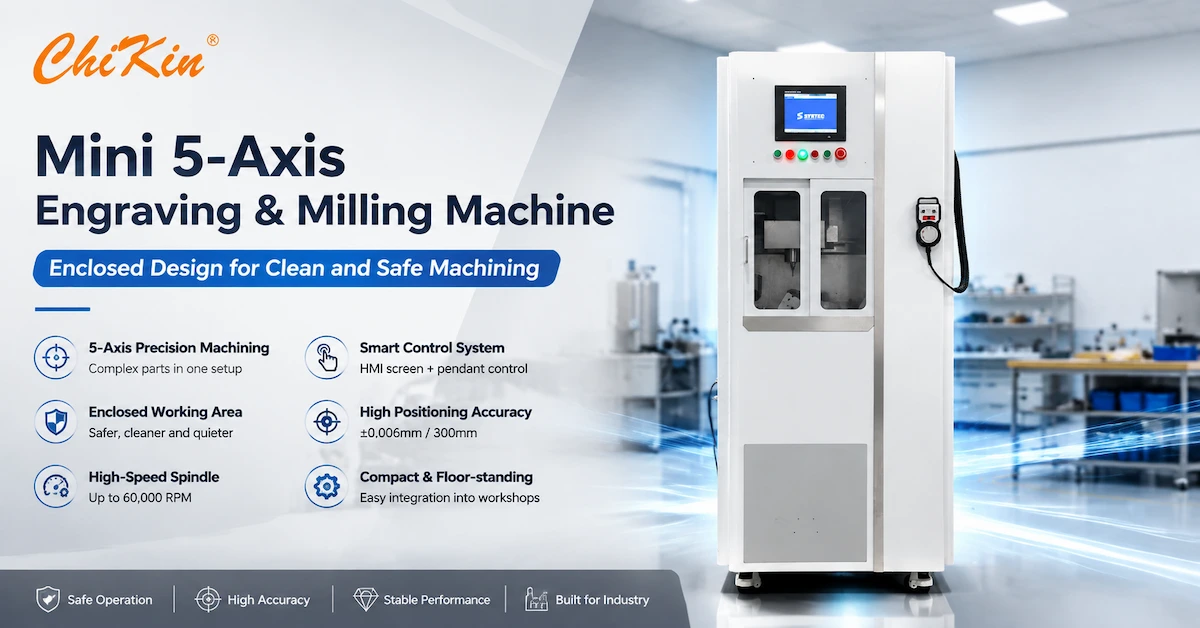
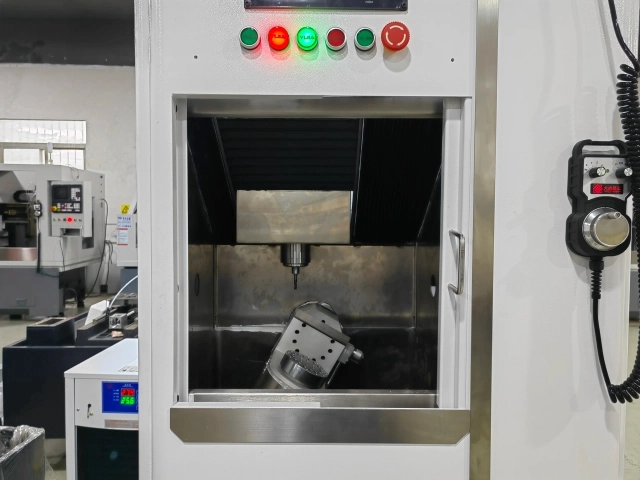
The supplied product images show a compact, floor-standing enclosed machining system with:
- Front observation windows
- Touchscreen HMI
- Physical control buttons
- Emergency-stop button
- Handheld pendant
- Enclosed work chamber
- Ventilation openings
- Mobile floor-standing cabinet
This type of enclosure can be useful when workshops want to separate the machining zone from the operator and surrounding production area.
The observation windows also allow the operator to monitor setup and machining without repeatedly opening the door.
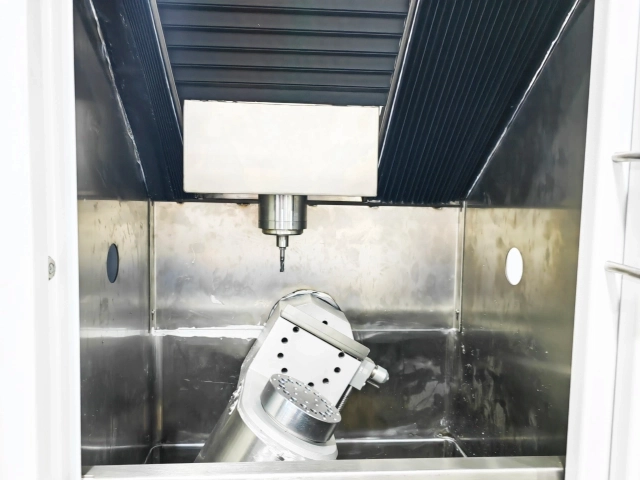
However, the exterior alone cannot confirm the complete kinematic structure, spindle system, rotary axes, or applicable material range. Those points should be verified from the final machine configuration.
What Do the Published Specifications Tell Buyers?
The product information supplied with the machine lists the following values:
| Specification | Listed Value |
|---|---|
| Maximum load | 10 kg |
| Maximum feed height | 200 mm |
| Operating platform | Ø150 mm |
| Spindle-to-platform distance | 30–200 mm |
| X/Y/Z travel | 200 / 170 / 170 mm |
| Principal axis diameter | Ø62 mm |
| Spindle speed | 0–30,000 / 0–60,000 rpm |
| Principal axis motor | 1.5 kW |
| Rapid X/Y/Z movement | 12 / 12 / 12 m/min |
| Processing speed | 6–12 m/min |
| Positional accuracy | ±0.006 mm / 300 mm |
| Resetting accuracy | ±0.006 mm / 300 mm |
| Listed surface finish | Ra3.2–1.6 |
| Processing accuracy | ±0.01 mm |
| Voltage | 220V±10% / 110V±10% |
| Machine dimensions | 750 × 800 × 1700 mm |
| Machine weight | 400 kg |
These values give buyers useful information about machine footprint, spindle capability, travel, workpiece size, and expected positioning performance.
One Specification Point Buyers Should Confirm
There is an important detail in the supplied product information.
The product title identifies the equipment as a Mini 5-axis Engraving and Milling Machine, while the visible specification table is headed “UV Laser Engraving Machine” and lists a 3-Axis Route X/Y/Z.
Before placing an order, buyers should therefore ask CHIKIN to confirm:
- Whether the quoted machine is 3-axis or 5-axis
- Which rotary axes are included in a 5-axis configuration
- Whether the specification table belongs to the exact model
- Whether the machine is spindle milling, laser processing, or available in different configurations
- Which parameters apply to the final quotation
Clarifying this before purchase is better than assuming specifications from a product title.
What Should a 5-Axis Engraving and Milling Machine Manufacturer Provide?
A professional Mini 5-Axis Milling Machine Manufacturer should provide more than a catalog specification.
Application Review
The supplier should first ask:
- What material will be processed?
- What are the maximum part dimensions?
- What geometry requires multi-axis machining?
- What tolerance is required?
- What surface finish is expected?
- Is the process engraving, milling, drilling, trimming, or combined machining?
- What is the expected production volume?
This helps determine whether the buyer actually needs a 5-axis system or whether a simpler 3-axis configuration can complete the job more economically.
Configuration Confirmation
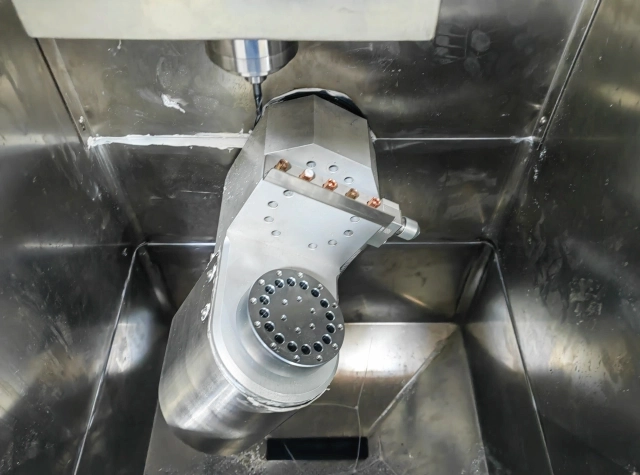
For a true 5-axis application, buyers should understand how the additional rotary axes are arranged.
Ask for:
- Axis layout
- Rotary-axis travel
- Rotary-axis accuracy
- Workholding method
- Maximum workpiece envelope during rotation
- Collision limitations
- CNC controller information
- CAM compatibility
A machine may have a compact table but still require additional clearance when the workpiece rotates.
Why Does Accuracy Need More Than One Number?
A common purchasing mistake is comparing machines only by a single advertised accuracy value.
For machining centres, accuracy can involve several different factors:
- Linear positioning
- Repeatability
- Rotary-axis positioning
- Spindle runout
- Interpolation
- Thermal stability
- Workholding
- Finished-part accuracy
The ISO 10791 family provides standardized test approaches for machining centres, including positioning, speed, interpolation, and finished test-piece accuracy; ISO 10791-7 specifically addresses cutting accuracy for machining centres with three to five simultaneous machining axes.
For buyers, this means the most useful question is not simply:
“What is your machine accuracy?”
Instead ask:
How was the stated accuracy measured, and can the supplier demonstrate it on a representative part?
Why Is Sample Machining Important?
Sample machining is one of the best ways to evaluate a supplier before purchasing precision equipment.
Send the manufacturer:
- CAD or STEP file
- Material information
- Required dimensions
- Critical tolerances
- Surface requirements
- Production quantity
Then evaluate the finished sample for:
| Test Area | Buyer Check |
| Dimensions | Are critical dimensions within tolerance? |
| Surface finish | Does it meet the required finish? |
| Detail quality | Are fine features reproduced cleanly? |
| Repeatability | Are multiple samples consistent? |
| Setup | Is fixturing practical? |
| Cycle time | Does productivity meet the target? |
| Tooling | What cutters and wear rate are required? |
A sample result provides more purchasing evidence than a machine photo.
Which Buyers May Need This Type of Machine?
Precision Component Workshops
Compact multi-axis machining can be useful for small components requiring machining from several orientations while reducing repeated manual repositioning.
Mold and Tooling Workshops
Mold inserts, electrodes, fixtures, and precision tooling may require detailed engraving, contouring, or multi-face machining.
R&D and Prototype Labs
A compact enclosed machine can suit environments where floor space is limited and engineers need frequent setup changes for prototype components.
Electronics and Small-Part Manufacturing
Depending on the final confirmed configuration, the machine may be considered for fixtures, small metal components, tooling, housings, or other precision-machined parts.
Material suitability should always be verified by sample processing.
What Should Buyers Check at the Factory?
When evaluating a Mini 5-Axis Milling Machine Manufacturer, buyers should focus on engineering and testing capability rather than factory photos alone.
CHIKIN states that Shenzhen ChiKin Automation Equipment Co., Ltd. integrates R&D, manufacturing, and sales, and its published company information includes CNC drilling, milling, cutting, and automation control-system development.
Buyers can review CHIKIN's company profile before supplier qualification.
Engineering Capability
Ask whether the manufacturer can review:
- 3D drawings
- Workholding
- Tool selection
- Axis configuration
- Machining sequence
- Controller requirements
Factory Testing
Before shipment, ask the factory to verify:
- Axis movement
- Spindle operation
- Positioning
- HMI and controls
- Emergency stop
- Door and enclosure
- Sample machining
- Repeated cycles
Customization
Customization may include:
- Rotary-axis configuration
- Fixture design
- Spindle selection
- Tooling
- HMI language
- Workholding
- Extraction or chip management
- Software or control options
Customization should solve an actual production requirement rather than simply add features.
3-Axis vs 5-Axis: Which Configuration Should Buyers Choose?
| Production Need | 3-Axis | 5-Axis |
| Flat engraving | Strong fit | Usually unnecessary |
| Basic pocket milling | Strong fit | Possible |
| Multiple angled surfaces | Multiple setups | Stronger |
| Complex 3D geometry | Limited | Better suited |
| Simple parts | More economical | May be excessive |
| Reduced repositioning | Limited | Strong advantage |
| Programming complexity | Lower | Higher |
| Investment level | Lower | Higher |
A buyer should not choose five axes simply because it sounds more advanced.
If most parts require only top-surface engraving or simple X/Y/Z machining, a 3-axis machine may offer a better return on investment.
A 5-axis configuration becomes more valuable when multiple orientations, angled features, or reduced part repositioning materially improve the process.
What Should Buyers Compare Between Suppliers?
Before comparing final quotations, normalize the technical scope.
Check:
- Actual axis count
- Working travel
- Rotary-axis configuration
- Maximum workpiece size
- Spindle power and speed
- Positioning accuracy
- Controller
- Included fixtures
- Tooling
- Machine enclosure
- Sample testing
- Documentation
- Training
- Warranty
- Spare parts
- After-sales service
CHIKIN also provides a technical FAQ covering equipment manufacturing and sourcing questions.
What Information Should You Send Before Requesting a Quote?
Prepare:
- Part drawing or 3D model
- Material
- Part dimensions
- Required tolerance
- Surface finish
- Required machining operations
- Production quantity
- Required axis configuration
- Factory voltage
- Available installation space
- Current production problem
This allows the supplier to recommend a machine according to the application instead of sending a generic quotation.
FAQ
What Should I Confirm First When Buying a Mini 5-Axis Engraving and Milling Machine?
Confirm the actual axis configuration, working travel, rotary-axis arrangement, spindle specification, workpiece envelope, controller, and machining accuracy before comparing price.
Why Does the Product Specification Mention 3-Axis Travel?
The supplied specification table lists X/Y/Z travel even though the product title refers to a 5-axis machine. Buyers should ask the supplier to confirm whether additional rotary axes are included in the quoted configuration.
Is 60,000 RPM Always Better for Engraving and Milling?
No. Suitable spindle speed depends on material, cutter diameter, cutting depth, feed rate, required finish, and machining strategy.
Should Buyers Request Sample Machining?
Yes. Sample machining helps verify dimensional accuracy, surface finish, tooling, workholding, cycle time, and repeatability on the buyer's actual component.
Is This Machine Suitable for Metal and Acrylic?
The final material capability depends on the confirmed spindle, tooling, machine rigidity, workholding, and process configuration. Buyers should send actual material and drawings for testing instead of relying on general assumptions.
What Should a Reliable Machine Factory Provide After Delivery?
Buyers should confirm documentation, installation guidance, operator training, spare parts, remote troubleshooting, warranty terms, and long-term technical support before ordering.
Conclusion
Choosing a Mini 5-Axis Milling Machine Manufacturer requires more than comparing spindle speed, machine dimensions, or quotation price.
Buyers should first verify the exact axis configuration and technical specification, then evaluate application engineering, sample machining, machine accuracy, customization, factory testing, and after-sales support.
The supplied machine information shows a compact enclosed platform with HMI control, pendant operation, a 1.5 kW spindle, listed speeds up to 60,000 rpm, a 200 × 170 × 170 mm X/Y/Z working range, and published positioning values. However, the difference between the “5-axis” product title and the “3-axis” specification table should be clarified before purchase.
For an application review, contact CHIKIN CNC and provide your part drawing, material, tolerance, dimensions, machining requirements, and expected production volume. CHIKIN's contact page provides its current sales and technical inquiry channels.