



PCB Drilling and Routing Equipment Overview
PCB Drilling and Routing Equipment is used to turn copper-clad panels into finished circuit boards with clean hole placement, edge shaping, and consistent board outlines. For buyers, the main problem it solves is accuracy: manual trimming or drilling can damage traces, create burrs, and slow down prototype or small-batch production. An enclosed CNC machine with a controlled motion system and operator interface helps keep processing repeatable while improving safety and part consistency on the shop floor.
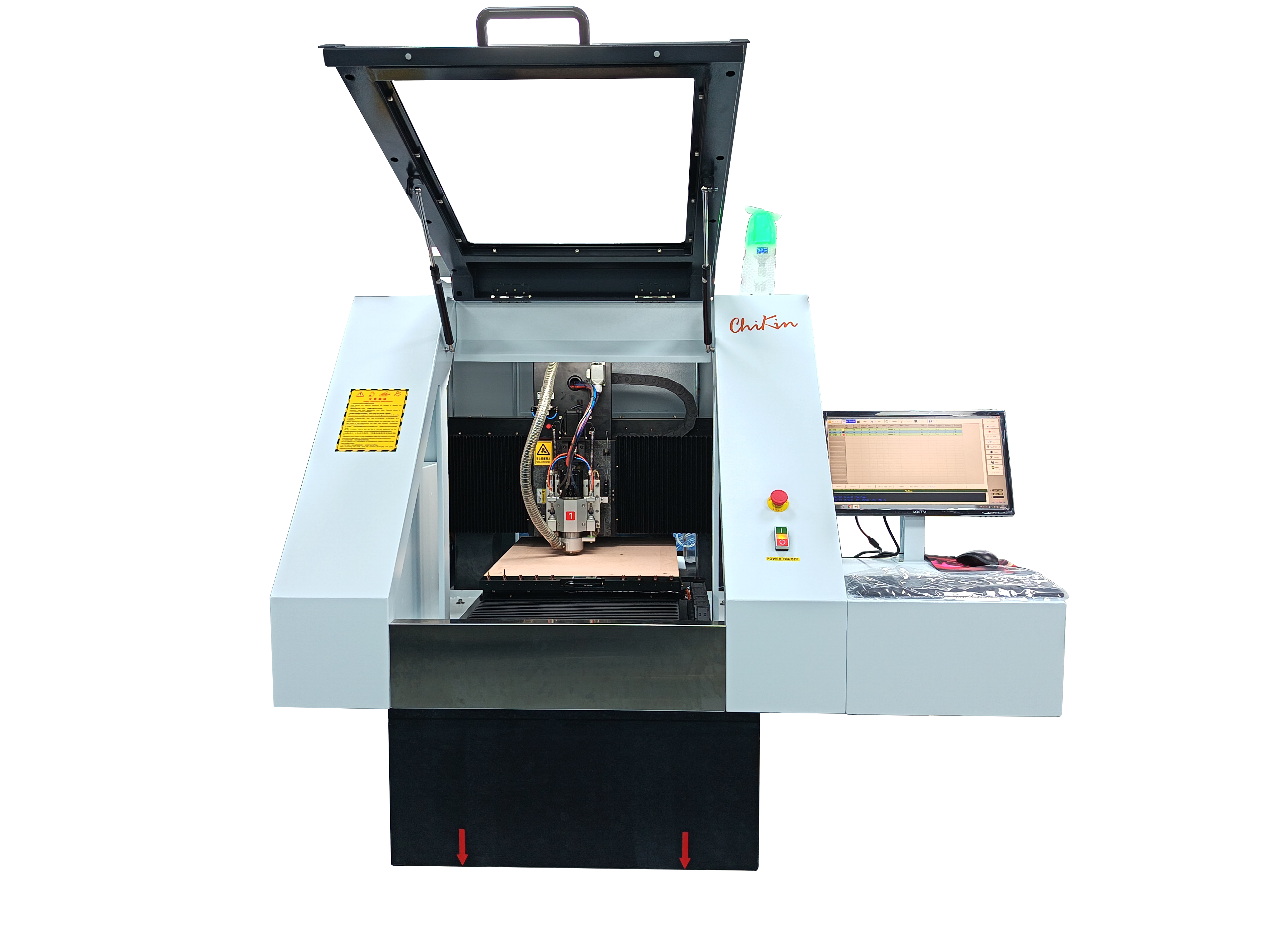
Based on the visible structure, this type of equipment appears to be a compact industrial cabinet machine with an enclosed work chamber, a top-opening lid supported by gas struts, an integrated control screen, and an internal moving head. The exact process cannot be confirmed from the image alone, so it should be treated carefully as a precision CNC processing platform that may be configured for laser machining, engraving, cutting, drilling, or routing-related tasks depending on the final build.
Machine Specification
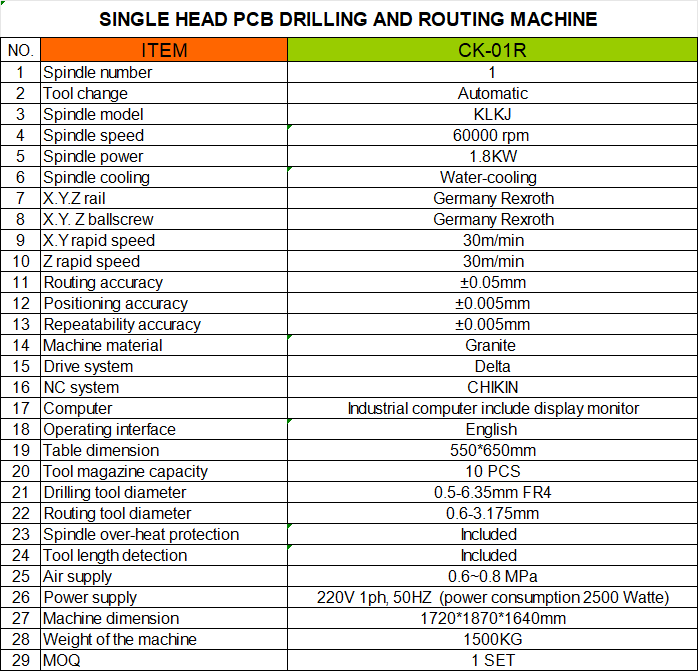
What the Machine Is Designed to Do
In PCB production, drilling and routing steps are critical because they define the electrical and mechanical quality of the finished board. Hole positions must align with component leads, vias, and mounting points. Board edges must be cut cleanly so the panel separates without cracking or excessive burr formation. A machine in this category helps reduce rework by combining motion control, enclosure safety, and a dedicated working bed in one workstation.
Typical functions buyers look for
Common tasks include PCB drilling, board contour routing, panel separation, slot cutting, and precision trimming for prototypes or short production runs. Related workshop users may also look for marking, engraving, serial number coding, or other small-part processing functions if the machine configuration supports them. Because the visible machine resembles an enclosed CNC processing system, its exact capability should be verified before purchase rather than assumed.
Visible Specifications and Machine Features
The product photos show several practical features that matter to operators and production planners. The machine has a fully enclosed cabinet-style body, which supports safer operation and helps contain debris, fumes, or light exposure depending on the process used. A front access opening provides entry to the workbed, while the top lid is assisted by gas struts for easier handling. A side-mounted monitor and control area suggest direct computer-based operation instead of manual-only adjustment.
Notable visible components
Key visible elements include an emergency stop button, start/stop controls, an internal work chamber, and a lower compartment that may serve as dust collection, waste removal, or service access. The interior shows a motion head or nozzle-like assembly above a flat bed. Those features indicate a machine built for controlled, repeatable fabrication rather than a general-purpose bench tool.
Materials, Build, and Finish Options
The outer body appears to use fabricated sheet metal in light gray or white, paired with a darker base and viewing cover. This kind of construction is typical for industrial equipment because it balances rigidity, serviceability, and enclosure safety. For PCB-related workflows, buyers often consider how the machine integrates with dust extraction, chip collection, enclosure windows, and access for fixturing flat panels.
Finish options, if offered by the manufacturer, may include machine paint color, panel labeling, control layout, and fixture design. Since those details are not visible in the image, they should be confirmed during specification review.
Manufacturing Process and System Integration
Equipment in this category is usually built from welded or fabricated sheet-metal panels, linear-motion hardware, wiring harnesses, control electronics, and a computer-driven interface. In practice, the value comes from how well the motion system, enclosure, and operator controls work together. A PCB fabrication machine must position tools accurately, hold the workpiece securely, and allow the operator to monitor the process without unnecessary exposure.
For a CNC drilling and milling machine for PCB workflows, buyers should ask how the machine handles positioning repeatability, spindle or tool-head configuration, fixture compatibility, and extraction management. If the system is instead laser-based, material compatibility and safety enclosure design become even more important. The visible cabinet suggests the machine is intended for supervised, enclosed production use.
Application Scenarios
This type of PCB drilling routing workstation is commonly evaluated for prototype labs, electronics manufacturing, industrial workshops, and small-batch production lines. It can be useful where board shape changes often, where turnaround time matters, or where operators need a controlled desktop-style station for fabrication tasks. In adjacent industries, a PCB Milling Machine or Printed Circuit Board Router may also be used for sign components, thin sheet processing, or other precision flat-part work.
Where it fits best
Buyers usually consider it for precision cutting of flat industrial parts, prototyping, board outline routing, marking serial numbers or barcodes, and workshop-scale production where enclosure and operator control are important. If the final configuration supports non-PCB materials, that should be verified case by case.
Quality Control and Buying Considerations
When comparing PCB Drilling and Routing Equipment, the most important decision factors are motion accuracy, enclosure safety, fixture design, service access, and compatibility with the intended production flow. Buyers should also confirm tool or head type, software control method, maintenance requirements, extraction needs, and the materials the machine is actually rated to process. Because the visible image does not reveal exact performance numbers, avoid making assumptions about thickness, speed, or precision without supplier documentation.
Before ordering, request the work area dimensions, supported file formats, power requirements, dust or exhaust setup, and any optional fixtures. If the machine will be used for high-mix prototyping, quick changeover and easy access may matter more than maximum throughput. For repetitive production, stable clamping and process consistency become the main priorities.
Customization and Next Steps
For projects that need a specific work envelope, a different control interface, or a tailored fixturing setup, customization should be discussed early. The enclosed platform shown here provides a strong base for adaptation, but the exact machine type, laser source or spindle configuration, and supported PCB processes need confirmation before integration into a production line.
If you are sourcing a PCB Cutting and Routing solution, share your board size, material stack-up, hole requirements, and target output volume. A supplier can then match the machine configuration to your process instead of forcing a generic setup. Contact the manufacturer or sales team to review the available configuration, control options, and accessory list for your application.